About Dream Case Files
Every week we take a real dream shared by a member of our Facebook community and give it the full treatment: the dream in their words, what it may mean, and a symbol-by-symbol breakdown. No generic definitions. Real dreams, real people.
The dream, shared by Leo in our Facebook group (lightly edited for readability):
A few things to know first. Orcas come to me a lot in dreams, and they are usually my friend or protector. My grandfather has passed away. And this was a dream inside a dream.
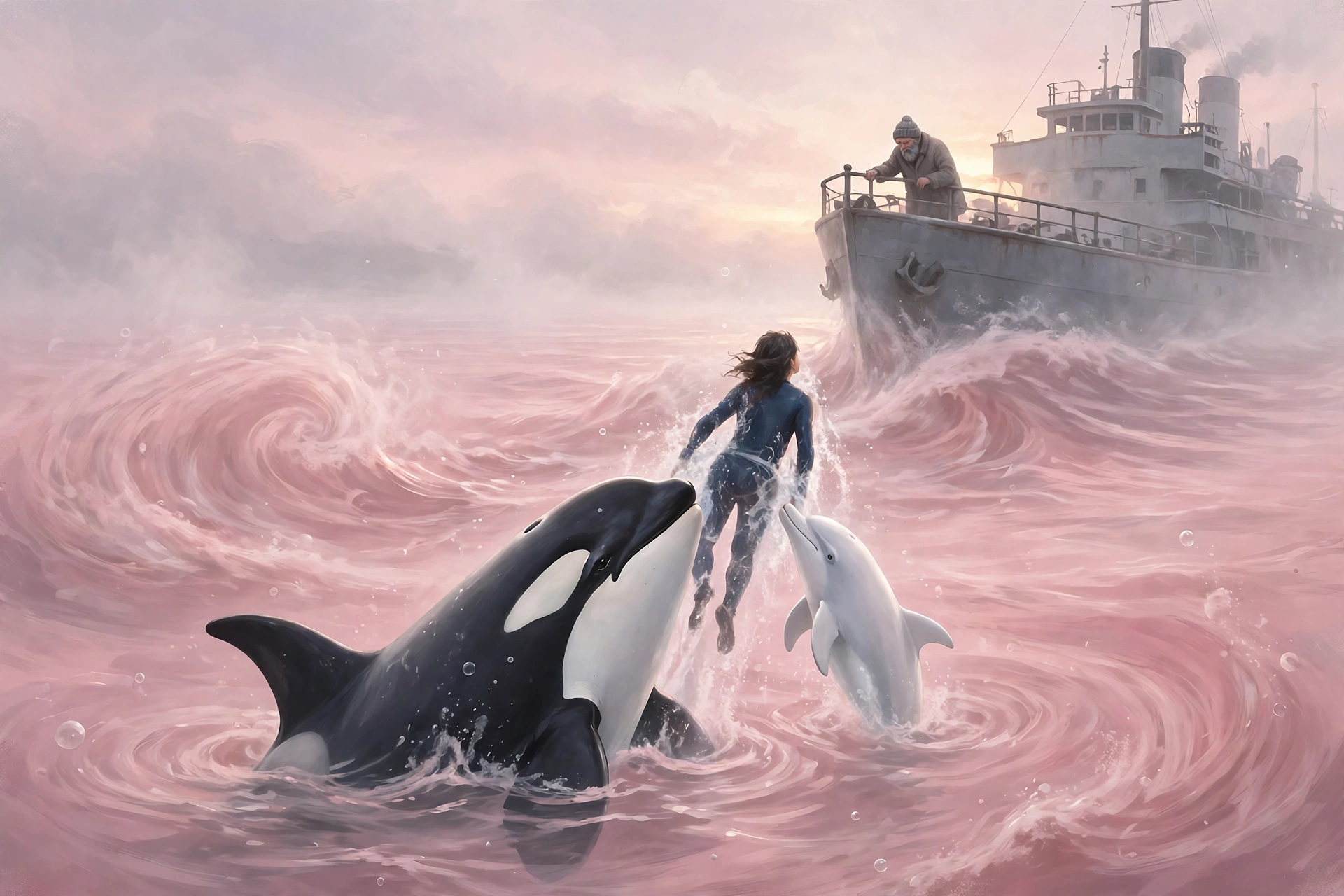
In the outer dream, my partner and I are at my grandparents’ original house, in their bedroom, going to bed. In the dream inside that one, I am in a pink ocean. A strong current is pulling me away from a giant grey ship, and my grandfather is on that ship. An orca and a white dolphin are with me. Both of them try to launch me into the air so I can get onto the ship, but it does not work. I remember telling them to take me to shore instead.
Then I wake up inside the dream, and my grandfather, the one who was on the ship, is the person waking me up. I woke up for real in a panic, with the feeling that I had been drowning in the dream.
Key takeaways
- Leo’s protectors do not fail him in this dream. The orca and the white dolphin try hard, and Leo is the one who changes the plan and asks for shore.
- The current does the quiet work in the middle of the dream. It pulls one way, toward open water and away from the ship, while everyone in the water tries to move the other way.
- The grandfather appears twice. First he is far away on the ship. Then he is close up in the bedroom where the dream started, and he wakes Leo himself.
The 50 dream symbols readers ask about most, in one free guide.
Get The 50 Most Common Dream Symbols, our free quick-reference guide, in plain English. We send one confirmation email first, then your download.
What this dream may be working through
A note on framing first, because Leo names a real loss at the top of his post. His grandfather has died. Read the ship, the current, and the waking at the end as his mind rehearsing a loss it has already lived through, and carrying love and responsibility under strain on a night when even sleep had layers. Nothing in this reading treats the dream as a visit from his grandfather, a message from him, or a sign about what comes next. It makes no prediction of any kind.
The dream starts in a bedroom that belongs to his grandparents. Leo and his partner go to bed in his grandparents’ original house, in their room. That choice of room matters. He does not fall asleep in a neutral place and then travel to the ocean. The whole inner dream launches from the grandparents’ bedroom, the most private room in their house.
Then the color arrives. The ocean is pink. Dreamers often report water in blues and greens and dark shades at night, so a pink ocean stands out in Leo’s own telling. It softens a scene that could have played as pure danger. He is being pulled away from someone he loves, and the water around him has a warm color to it. Both things happen at once in this dream, grief and warmth in the same water, and the dream does not ask him to pick one.
On the evidence: this reading follows the continuity idea in dream research, linked to G. William Domhoff, that dream scenes tend to track the concerns and relationships a person carries while awake. A grandson who still dreams often about his late grandfather, in his grandparents’ own bedroom, fits that pattern on its face. The link gives us a place to start. It does not prove what Leo’s dream meant to him.
The middle of the dream is effort. The orca and the white dolphin try to launch him into the air toward the ship. Leo says orcas come to him a lot and act as a friend or protector, so these are not random animals. They are his regular crew. They try the bold plan, the leap onto the ship, and it does not work. What happens next is the detail I keep coming back to. Leo tells them to take him to shore. He does not keep ordering attempts at the ship. He asks for solid ground.
On the evidence: research on grief dreams by Joshua Black and colleagues found that dreams about a person who has died are common after a loss, and that many of those dreams feel comforting to the dreamer, even when the plot itself is sad. Black’s work also describes a category where the dreamer knows, inside the dream, that the person has died. Leo’s dream sits close to that second pattern. He knows his grandfather belongs on the far side of something, on the ship, and the plot is built around the distance itself.
Then the dream folds. Leo wakes up inside the dream, back in the frame where he went to bed, and his grandfather is there waking him. The man he could not reach across open water is suddenly at the bedside. He does the most ordinary thing a grandparent does. He wakes the kid up. Leo then wakes for real in a panic. The drowning feeling from the inner dream is still on him in his actual morning. Which layer left that feeling on him, the pink ocean, or the bedroom where his grandfather stood close enough to touch?
The symbols, one by one
The grandparents’ house, and their bedroom. The outer dream never leaves home ground. Leo falls asleep in his grandparents’ room, and he wakes inside the dream in that same frame. Our page on finding new rooms in a house you know covers the close cousin of this setting, a familiar house that behaves in unfamiliar ways.
On the evidence: in the State of Dreams count, houses and rooms appeared in 30 of the dreams we counted. That tells us home settings show up often for our dreamers. It does not assign Leo’s grandparents’ bedroom a meaning on its own.
The pink ocean, and the current. Water in this dream has a color and a direction. The color is warm. The direction is away. The current pulls Leo from the ship without malice and without a storm, steadily, the way time itself pulls a grandchild away from a grandparent’s generation. Readers who want the wider water picture can start with our guide to calm water in dreams, which covers what still water tends to carry, because Leo’s water is the opposite case, water on the move.
On the evidence: in the State of Dreams count, water appeared in 23 of the dreams we counted. No direct study backs a fixed meaning for pink water in a dream. The color reading above comes from Leo’s own telling, where the pink is the detail he kept, set against a current he also kept.
The grey ship, and his grandfather on it. The ship is giant and grey, and his grandfather stays on it for the whole inner dream. Ships in dreams often carry people who are leaving, or who have already left, and this one never docks and never turns back. His grandfather does not call out, wave, or jump in. He is simply aboard, and the distance between the ship and the swimmer is the fact the dream keeps returning to.
The orca and the white dolphin. Leo gives us their job description before the dream even starts: friend, protector. In the water they act on it. They try to launch him toward the ship, a big physical effort, the kind of help that works in dream logic right up until it does not. One animal is black and white and huge, the other is white and smaller, and Leo lists them as a pair, two protectors working the same problem from the same side, his side.
On the evidence: no direct study backs a fixed meaning for an orca or a dolphin appearing as a protector in a dream. This reading comes from the dreamer’s own history with the symbol, which Leo states plainly at the top of his post, and from dreamer reports in our community where a recurring animal keeps the same role across many dreams. When a dreamer tells us what an animal usually does in their dreams, that record outweighs any dictionary entry.
Telling them to take him to shore. This is Leo’s one spoken decision in the dream, and he remembers making it. Shore is not the ship. Shore is the end of the attempt, dry land, the place where the swimmer stops swimming. If you have had the version of this dream where you kept trying for the ship all night, what did your hands feel like when you woke up?
Waking inside the dream, and the drowning panic. A dream inside a dream gives Leo two awakenings, and they carry opposite feelings. In the first, his grandfather wakes him, gently, in a bedroom. In the second, he wakes for real in a panic, with a drowning feeling still on him. Our guide to drowning in dreams looks at that breathless waking feeling in more depth, and our page on dreaming of someone who died collects the grief dreams members share with us most often. There is also a plainer companion piece on a dead person talking to you in a dream, for readers whose version had words in it, because Leo’s grandfather says nothing at all.
On the evidence: false awakenings are a documented sleep experience in the sleep literature. In a false awakening, you wake up inside a dream and the dream continues, and people often report them alongside vivid and anxious dreams. No study assigns a grief meaning to the false awakening itself. In Leo’s case the sequence is what carries the weight: ocean first, bedroom second, panic last.
The question to sit with
Leo’s protectors could not get him onto the ship, so he asked them for shore instead, and then his grandfather woke him in the bedroom where it all started. If this were your dream, would you have kept trying for the ship, or would you have asked for shore when Leo did?
Had a dream that stuck with you? Share it in our Facebook group. Not on Facebook? Drop your dream in the comments below. The most vivid ones get the full case-file treatment.
Prefer to listen? This series is also a podcast, Dream Case Files on Spotify: https://open.spotify.com/show/5TWggSlCTBsRYGsnpLJDDy
Leave a Reply