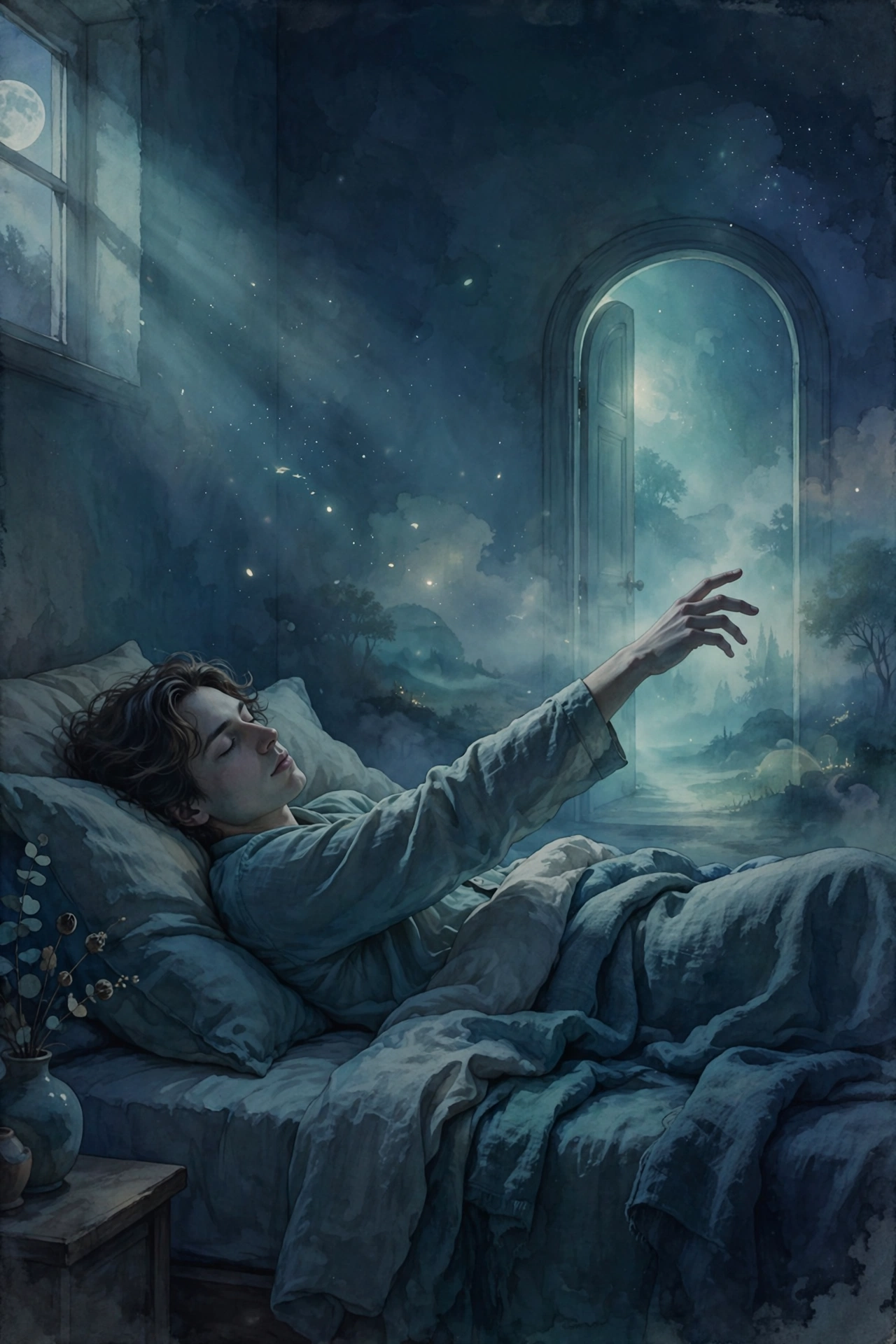
A Harvard neuroscientist has spent a decade studying the figure that stands beside the bed. This week, a crowd went looking for him. Google Trends shows searches for Baland Jalal’s sleep paralysis research up more than 5,000 percent this week. The spike followed his long New Scientist interview on November 10, and his book The Phantom Mind reached UK shops from Allen Lane on November 12. A US edition from MIT Press follows in January.
The book argues that these borderland states between sleep and waking show how the brain builds a self.
Sleep paralysis is the brief state where you wake while the body is still switched off for dreaming. You cannot move, breathing feels shallow, and many people sense someone in the room. We cover the experience itself in our guide to sleep paralysis and what it means.
At a Glance
- The news: Harvard neuroscientist Baland Jalal published The Phantom Mind this week, alongside a long New Scientist interview.
- His central claim: the figure in the room is built by the brain. Dream machinery keeps running while you wake, and the mind fills the gap with a presence.
- Culture picks the costume: in Egypt and Denmark, the same state was read as a jinn by one group and stress by the other, and the frightening reading came with longer, worse episodes.
- His four steps: reappraise the episode, step back from the fear, focus on something loved, and let the body relax. In one small pilot study, episodes fell by about half over eight weeks.
A Teenage Episode That Set His Career
Jalal met the figure before he studied it. He told New Scientist that his first episode came at about 18 or 19. He woke and could not move or speak. A shadow-like creature came toward him, pressed on his chest, and strangled him, and he was sure he was going to die. He fought his way out of it, and the episode set his direction: he would become a scientist and work out what had happened to him.
The path that followed explains the shape of his research. Jalal grew up in Denmark and went to Egypt, where scholarships took him to the American University in Cairo. After Cairo came California, then a PhD at Cambridge. He is now at Harvard, and his publisher notes that he has explored sleep paralysis in six countries over the past decade. Expertscape ranked him the world’s leading sleep paralysis expert in 2023.
On the evidence: the episode account and career sequence are his own telling, from the New Scientist interview. The six-country detail comes from his publisher’s author page.
How the Brain Builds the Figure
His explanation starts with the machinery of REM sleep. In REM, the stage of vivid dreams, the body is paralysed head to toe so you cannot act them out. Sometimes the outer brain wakes while that paralysis is still switched on. You get awareness without movement, and leftover dream imagery spills into the room around you.
Jalal describes the brain as a prediction machine. It does not wait for the senses to deliver a finished picture. It guesses, and fills gaps with whatever fits the guess. His publisher describes the apparitions as the brain making sense of an impossible situation until you wake fully and they fade.
The figure itself has a more specific proposed source. In a 2014 paper, Jalal and neuroscientist V. S. Ramachandran argued that the sensed presence comes from a disturbance in the brain’s body map, the system tracking where you end and the room begins. When that map glitches, the mind projects a version of the self into the space beside the bed, and the projection gets read as an intruder. The dreaming brain dresses it up: reasoning areas go quiet in REM, emotional areas run about 30 percent hotter than in waking life, and the systems that attribute intentions to other minds stay on. A presence built that way arrives with a personality, rarely a friendly one. The long tradition behind that visitor, from the Old Hag of folklore to the demon on the chest, is covered in the flagship guide.
Jalal is plain about the limits. Why we see monsters at all is still theoretical, he told New Scientist. Nobody has yet scanned a brain mid-episode, partly because the state is usually harmless and hard to fund. The body map account is a serious proposal, not a settled fact.
One State, Three Countries, Three Different Visitors
His comparison work is the strongest part of the program. Jalal and his Harvard colleague Devon Hinton surveyed people in Denmark and Egypt, whose samples lived the same state very differently. In their 2013 study, 44 percent of the Egyptian sample had experienced sleep paralysis, against 25 percent of the Danish sample. The Egyptians reported roughly three times as many episodes across their lives.
The interpretations split harder than the rates did. About 90 percent of the Danes put it down to the brain and stress, with nothing supernatural involved. Many Egyptians named a jinn and feared it intensely. About half of the Egyptians who had experienced an episode believed it could kill them. Within the Egyptian sample, the people who read the episode as a supernatural attack reported more fear, and they stayed paralysed longer. Our guide to Islamic dream interpretation sets out the framework behind that reading in more detail.
Italy gave the pattern a third costume. In the Abruzzo region, the visitor is the Pandafeche, a witch, ghost, or cat-like humanoid in local telling. Jalal, Andrea Romanelli, and Hinton interviewed 67 people there with sleep paralysis. More than half had sensed a presence in the room. Two in three felt something touch them. Forty-two percent feared they might die during an episode, and more than a third of local sufferers in the team’s earlier work believed the Pandafeche might be behind their attacks.
Jalal also argues the idea itself travels, by priming. A girl warned by her grandmother about night monsters goes to bed with her emotional brain on alert, jolts out of REM more easily, wakes frozen, and the imagery builds the monster she was warned about. Then she tells her friends. His own episodes took local material the same way. In Egypt during the Libyan revolution, with Gaddafi on the news daily, the figure over him one night was Gaddafi. The room supplies the parts: a poster becomes a face, a glass becomes a skull.
Free: The 50 Most Common Dream Symbols Guide
Get the free guide when you join the DreamEvaluator mailing list.
Fear Is the Fuel in the Loop
Read those country numbers together and a loop appears. Fear raises heart rate and speeds up breathing. Panicky breathing fights the paralysis and worsens the chest pressure. The episode feels longer, and the memory of it is uglier. The next night, sleep is anxious and broken, and broken sleep invites another episode. Round it goes.
Belief sits inside that loop, which is why the same state can be a bad minute in Copenhagen and a brush with death in Cairo. If you expect a killer, a hyper-alert brain will build you one and keep the alarm ringing. If you expect a glitch, the glitch passes. It is the thread his book keeps returning to: what you believe about the figure changes what the figure does to you. The fuller picture of what sleep paralysis means across the centuries sits in the flagship guide.
Four Steps for the Middle of an Episode
Jalal built a method out of that loop: meditation-relaxation therapy, first described in a 2016 paper and tested since in a small pilot. The four steps are used during an episode, and each pulls a lever the research points to:
- Reappraise. Remind yourself what this is. Sleep paralysis is common, temporary, and harmless, and the figures are dream fragments rather than visitors.
- Distance. Step back from the fear. There is no danger to react to, and fear stretches the episode out.
- Focus inward. Hold your attention on something positive and emotionally loaded: a loved face, a happy memory, a prayer.
- Relax. Let the muscles stay soft. Do not strain to move or fight your breathing. The paralysis ends on its own.
The pilot evidence is small, and he says so. In a 2020 study in Frontiers in Neurology, Jalal and colleagues taught the method to people with narcolepsy in Italy who had frequent episodes. After eight weeks, the group using the steps had about half as many sleep paralysis days and roughly 54 percent fewer episodes in the final month than a deep breathing group. Ten people took part. Jalal calls the results promising and preliminary, and a follow-up study is under way. This is his published method, reported as research news. Anyone whose episodes are frequent or wrecking their sleep should talk to a doctor rather than rely on a summary, ours included.
What This Means for Your Own Nights
Most readers here meet the figure in dreams rather than half-awake, and the research still speaks to them. The two states run overlapping machinery. Both build agents out of spare parts, give a feeling a face, and let the face act. The figure by the bed embodies a threat the mind cannot name. The intruder inside an ordinary dream is often doing the same job with the lights off.
Lucid dreaming is the friendly cousin here: the sleeper knows they are dreaming and can sometimes steer, and Jalal’s account of one borderland state helps explain the other. Readers who wonder about the safety of that territory can compare his view with our piece on whether lucid dreams are dangerous. Readers who approach these nights through the classical tradition will find its framework in Ibn Sirin’s dream interpretations.
One idea from the interview is worth keeping. A person in sleep paralysis can still choose: ask them mid-episode to pick between two drinks and they can pick, where a sleepwalker cannot. The sleeper is a participant in the state, and participants can be taught.
So here is the question we would like this community to answer. If you have met the figure, in an episode or in a dream, what did it look like, and what did you believe it was at the time? A jinn, a hag, a demon, a glitch? Tell us in the comments. On Jalal’s evidence, the differences between your answers are where the real story lives.
The full guide to the most common dream symbols is at https://dreamevaluator.com/free-dream-symbols-guide/ and it comes free when you join the mailing list.
Get the free guide when you join the DreamEvaluator mailing list.
Prefer to listen? Dream Case Files, our podcast, gives real member dreams the full treatment every week: https://open.spotify.com/show/5TWggSlCTBsRYGsnpLJDDy
Dream interpretation is for self-reflection and entertainment, not medical or psychological advice.
Sources
New Scientist interview with Baland Jalal by Grace Wade, November 10, 2026. The Phantom Mind, Allen Lane, 2026. Jalal and Hinton, Culture, Medicine and Psychiatry, 2013, and Transcultural Psychiatry, 2014. Jalal, Romanelli and Hinton, 2015 and 2020. Jalal and Ramachandran, 2014 and 2017. Jalal et al., Frontiers in Neurology, 2020.
Leave a Reply