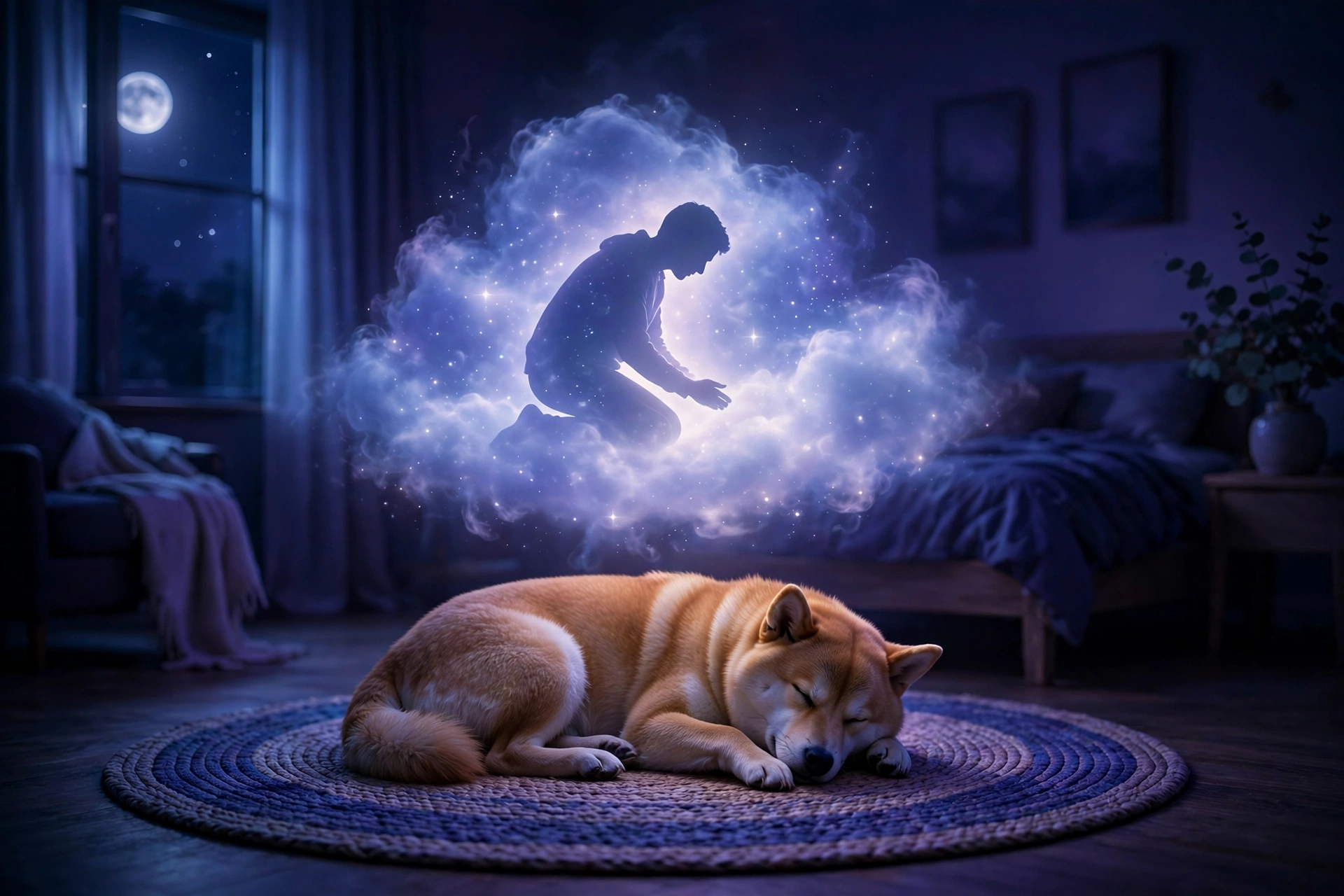
The paws start first. Little paddling motions, like she is running through grass she can smell and you cannot. Then a muffled bark, squeezed down to a whimper, and her tail thumps the floor twice. Your dog is asleep on the rug, and she is somewhere else entirely. The question every owner asks at that moment is the one you just typed into a search bar: is she dreaming about me?
Short version: she is almost certainly dreaming, and you are the likeliest thing in the dream. The longer version is better, because the science behind it is genuinely good.
The Short Answer
Dogs cycle through the same sleep stages we do, including REM, the stage where vivid dreams happen. Their dreams are built from the day they just lived: walks, meals, play, smells, and the people at the center of all of it. Sleep researchers cannot read a dog’s dream like a book, and this page will not pretend otherwise. But every line of evidence we have, brain recordings, behavior, and memory research, points the same way. Dogs dream about their daily lives, and for most dogs, their owner is the daily life.
At a Glance
- Dogs dream: they reach REM sleep about 20 minutes after falling asleep, on a cycle of roughly 20 minutes.
- Dreams replay the day: animal brain studies show waking experiences rerunning during sleep, in order.
- Owners are the center of a dog’s day: sleep experts argue that makes owners the likeliest cast of a dog’s dreams.
- Twitching paws and soft barks are REM showing: puppies and older dogs show them most, because they dream the most.
Free: The 50 Most Common Dream Symbols Guide
Get the free guide when you join the DreamEvaluator mailing list.
Dogs Reach the Dream Stage Fast
Dogs run on a shorter sleep cycle than we do. A person takes about 90 minutes to loop through the stages of sleep. A dog does it in roughly 20. About 20 minutes after your dog falls asleep, she reaches REM, rapid eye movement sleep, the stage tied to vivid dreaming in every mammal studied so far. Her eyes move under closed lids. Her breathing goes uneven. Measured on an EEG, her brain shows activity close to waking levels. Dogs spend about a tenth of their sleep in REM. We spend about a quarter of ours there.
On the evidence: noninvasive sleep studies on family dogs, including work from the Family Dog Project in Hungary, record the same REM and non-REM stages found in people, with REM starting about 20 minutes into sleep. The stage match is measured fact. What happens inside the stage is where careful inference begins.
The Dreaming Brain Replays the Day
The strongest clue about what any animal dreams comes from a study that used rats. In 2001, MIT researchers Kenway Louie and Matthew Wilson recorded the brain cells of rats running a maze, then recorded the same cells while the rats slept. During REM, the patterns fired again in the same order, so precisely that the team could tell which stretch of the maze the rat was revisiting. The sleeping brain was rerunning a real experience, turn by turn.
Dogs have larger, more layered brains than rats, and their days hold more than a maze: routes, routines, other animals, and people. The working assumption in sleep science is that a dog’s dreams are assembled the same way the rat’s were, out of what the day actually contained. Dream researchers call the human version of this the continuity pattern: dreams are built from waking life, weighted toward what the dreamer cares about.
On the evidence: the MIT maze study (Louie and Wilson, 2001) showed exact replay of waking brain patterns during sleep. No study can ask a dog what it saw, so dog dream content is read from this replay evidence plus behavior, not observed directly.
When the Off Switch Failed, Dogs Acted Out Their Days
During REM, a small structure in the brainstem called the pons keeps the large muscles switched off, so the dreamer cannot act the dream out. In classic experiments from the early decades of sleep research, when that switch was disabled in sleeping animals, they got up and performed the behaviors of their waking lives. In dogs, the performances were breed-typical. Pointers pointed at dream birds. Retrievers went through the motions of retrieving. Whatever the dream was, it looked like an ordinary day in that dog’s life, played out loud.
On the evidence: these were lesion studies beginning with Michel Jouvet’s work in the 1960s. They are the reason scientists say dog dreams draw on daily routines rather than invented fantasy. The studies are old and would not be run the same way today, but nothing since has contradicted them.
Sleep Spindles File the Day Away
There is a quieter line of evidence. Dogs produce sleep spindles, brief bursts of brain activity during non-REM sleep that, in people, help move memories into long-term storage. Researchers in Hungary recorded spindles in family dogs and found they shifted after the dogs learned new commands, the same pattern seen in us. A dog’s night is not idle time. It is sorting the day: the walk, the training, the door opening, your voice at the end of it.
On the evidence: Iotchev and colleagues reported the first sleep spindle data in dogs in 2017, and follow-up work tied spindle changes to learning. This is memory processing measured on EEG. It supports the replay picture without claiming to read any single dream.
So Is It You in the Dream?
Here is where measurement hands over to expert judgment, and this page labels the handover rather than hiding it. Deirdre Barrett, a psychologist at Harvard Medical School who studies dreams, puts it this way: since dogs are extremely attached to their human owners, it is likely they dream of your face, your smell, and of pleasing you or annoying you. Her reasoning is plain continuity. Human dreams are built from waking life and weighted toward the people we are attached to. A dog’s waking life is more concentrated than ours. For most dogs, one or two people are the weather of every day: food, walks, play, comfort, correction. If dreams replay the day, those people are the cast.
One more finding, and owners tend to keep this one. In MRI work at Emory University, awake dogs lay in a scanner while scent samples were presented to them. The smell of a familiar human lit up the caudate nucleus, the brain’s reward center, more strongly than the smell of food or of an unfamiliar person. Awake, your scent is close to the best thing in your dog’s world. Asleep, the dreaming brain works from the same material.
On the evidence: Barrett’s owner claim is expert inference from the continuity pattern, quoted widely since 2016, not a measurement. The scent result is measured (Berns and colleagues, 2015, awake-dog MRI). No study has decoded the content of a single dog dream, and any source that claims one has is selling something.
What Owners Actually See
The paddling paws, the muffled bark, the tail thumping a rug at 2 a.m. That is REM, visible from the outside. Some dogs add running motions, soft growls, or a sigh and a full-body settle when a dream lets go of them. Puppies show it more, and so do older dogs, because both spend more of their sleep in the dream stage. Stanley Coren, the canine psychologist who wrote a book on dog dreams, adds a size pattern: small dogs seem to dream more often, in shorter bursts, while large dogs dream less often and for longer each time.
On the evidence: the puppy and senior pattern follows from their larger REM share and is well documented. Coren’s size pattern is an inference from sleep cycle length across breeds, widely cited but not pinned to one study. Treat it as a good rule of thumb, not a law.
Can Dogs Have Bad Dreams?
Probably, yes. If dreams replay the day, a frightening day can be replayed too. Owners of rescue dogs sometimes report a new dog crying out or startling awake in the first weeks at home, then settling as the days being replayed turn kind. If your dog seems caught in a bad one, the standard advice is gentle: say her name softly and let her surface on her own. A dog woken mid-dream can snap before she knows where she is. It is the same startle we feel when someone shakes us out of a nightmare.
On the evidence: no study isolates dog nightmares. The claim rests on the replay evidence above and on owner reports. The wake-gently advice is standard guidance from veterinarians and behaviorists.
When the Dream Runs the Other Way
Dogs dreaming of us is only half the traffic. Owners dream about their dogs constantly, and those dreams carry readings of their own. A dog in your dream usually points at loyalty, protection, and the state of your closest bonds. Our page on what it means when you dream about a dog walks through the friendly, aggressive, and lost-dog versions. Cats carry a different register in dreams, independence and intuition rather than loyalty, which is why dreaming about a cat reads so differently even in the same household.
And when the dog in your dream is one who has died, the dream belongs to grief as much as to sleep. Those visits can be the best dreams a grieving owner gets all year. Our page on dreaming of a dead pet treats them with the care they deserve.
What to Watch for Tonight
- The 20 minute mark: REM starts about 20 minutes after she drops off. That is when the paws start.
- Paddling and running motions: the classic sign she is inside an active dream rather than merely asleep.
- Soft sounds: muffled barks and whimpers are the voice joining in under the muscle switch.
- A tail thump: owners read a happy dream into it, and the day-replay evidence gives them decent grounds.
- Let her finish: the dream is part of how her brain files the day. Today’s day, the one she spent with you, included.
Frequently Asked Questions
Do dogs dream about their owners?
Likely, yes. Dogs dream during REM sleep, animal studies show dreams replay waking experience, and an owner is the largest part of a dog’s waking life. Harvard dream researcher Deirdre Barrett argues dogs probably dream of their owner’s face and smell. It is strong inference, not direct proof, because no one can ask the dog.
How can I tell if my dog is dreaming?
Watch about 20 minutes after she falls asleep. Dreaming dogs show rapid eye movement under closed lids, uneven breathing, twitching paws, and sometimes soft barks, whimpers, or tail thumps. That cluster is REM, the dream stage.
What do dogs dream about besides their owners?
The rest of the day. Walks, meals, play, other dogs, and smells that mattered. Dogs experience the world nose-first, and at least one philosopher of animal minds, David Peña-Guzmán, argues their dreams are probably led by scent rather than pictures. Whatever form they take, the raw material is the dog’s own routine.
Should I wake my dog if she is twitching in her sleep?
No. Twitching is normal REM behavior, and the dream is doing memory work. If she seems distressed, call her name softly from where you are rather than touching her. A dog startled awake mid-dream can snap before she knows where she is.
Why does my puppy dream so much?
Puppies spend a larger share of their sleep in REM than adult dogs do, and so do senior dogs. More REM means more visible dreaming: more paddling, more twitching, more small sounds. It is a sign of a brain doing heavy filing work, which is exactly what a puppy’s brain is doing.
Want the Full Picture?
Your dog’s dreams are built from her days. Yours are built from yours, and they repay a closer look. Grab the free 50 Dream Symbols Guide at https://dreamevaluator.com/free-dream-symbols-guide/ and it comes free when you join the mailing list. The full dream meanings library is there too when a symbol from your own night needs reading.
Get the free guide when you join the DreamEvaluator mailing list.
Prefer to listen? Dream Case Files, our podcast, gives real member dreams the full treatment every week: https://open.spotify.com/show/5TWggSlCTBsRYGsnpLJDDy
Dream interpretation is for self-reflection and entertainment, not medical or psychological advice. For questions about your dog’s sleep or health, your veterinarian is the right call.
Leave a Reply