About Dream Case Files
Every week we take a real dream shared by a member of our Facebook community and give it the full treatment: the dream in their words, what it may mean, and a symbol-by-symbol breakdown. No generic definitions. Real dreams, real people.
The dream, shared by Bliss in our Facebook group (lightly edited for readability):
I had this dream that I went to my husband’s girlfriend’s house. I saw some of my things there. I told the girl that these are my things, that I am taking them back. But the only thing I took was a bunch of spoons. I explained what the man is doing to me. She was begging me. We were even talking and laughing together. Then I woke up.
Key takeaways
- Bliss walks into the other woman’s house and finds her own belongings already living there.
- She says she is taking her things back, then takes only one thing: a bunch of spoons.
- The dream ends with the girlfriend begging, and then the two women talking and laughing together, while the husband never appears at all.
The 50 dream symbols readers ask about most, in one free guide.
Get The 50 Most Common Dream Symbols, our free quick-reference guide, in plain English. We send one confirmation email first, then your download.
What this dream may be working through
Start with a plain boundary, because this kind of dream invites the wrong conclusion at breakfast. A dream about a husband’s girlfriend is not evidence about a real husband. It is not a report from the night, and it cannot tell Bliss, or anyone, what another person has or has not done while awake. What it can show is how her own mind staged a question about trust, place, and being replaced, and then, unusually, let the staging end in laughter instead of a fight.
Notice who is missing. The husband is the reason both women are in the scene, and he never walks into it. Bliss does not confront him. She confronts the girlfriend, in the girlfriend’s own house, and the confrontation keeps softening as it goes. First a claim: these are my things. Then a small, odd taking: only spoons. Then an explanation, woman to woman, about what the man is doing to her. Then begging from the girlfriend, and then the two of them talking and laughing together. The emotional arc runs from intrusion to alliance. That arc is the dream.
On the evidence: this reading follows the continuity idea in dream research, linked to G. William Domhoff, that dream scenes tend to track the concerns a person carries while awake. A dream that rehearses a trust worry in this much domestic detail is best read against waking questions about security and place in a relationship, not as a claim about a third person.
On the evidence: dreams also work as social rehearsal in one well known account, the social simulation idea developed from Antti Revonsuo’s work, where dreaming minds practice social encounters, alliances, and conflicts. Bliss’s dream fits that shape closely on its surface: a hard conversation gets played out, and the imagined outcome is not violence or humiliation, but the other woman listening, pleading, and then laughing with her. That fit is a reason to offer the reading, not proof of what the dream meant.
There is a second, quieter reading in the belongings. Bliss finds her things already inside the other house, as if part of her daily life had been moved without her. She announces a full taking back, and then her hands choose spoons. Spoons are small, daily, feeding things. Nobody stages a dramatic reclaiming and grabs cutlery unless the dream is pointing at the ordinary layer of a shared life: meals, routines, the small repeated acts that make a household hers. Read that way, she is not reclaiming property. She is naming what she actually wants back, and it is modest and specific.
On the evidence: partner dreams have been studied directly. Dylan Selterman and colleagues reported in 2014 that dreams about a romantic partner related to how the dreamer and partner perceived each other the next day. That study supports taking relationship dreams seriously as part of waking relationship life. It offers no support for treating a dream character as evidence about a real person’s behavior.
In folk dream tradition, an other woman in a dream is often read as a warning about a rival, and a house you do not own as someone else’s territory in your life. Those readings come after the psychological one here, and we label them for what they are: tradition, passed along in dream books and sayings, not findings from a study. The tradition also tends to stop at the warning. Bliss’s dream does not stop there, which is part of why it is worth a full case file.
The symbols, one by one
The girlfriend’s house. Bliss does not meet the other woman in a neutral place. She goes to her house, and walks in. A house in a dream often stands in for a life with its rooms and rules, and this one belongs to the rival. Our page on a house with unknown rooms covers the close cousin of this symbol, where the strange rooms are inside a home the dreamer thought was hers.
On the evidence: in the State of Dreams count, houses and rooms appeared in 30 of the dreams we counted. Bliss’s house sits at the far end of that group, a house that is not hers at all, which she enters anyway.
Her things, already there. This is the detail that stings first. Her belongings are not being carried in as she watches. They are already settled inside the other woman’s home. As a picture, it says the displacement she fears is not starting, it has already happened, quietly, in the background of daily life. What in your own routine would hurt most to picture already set up in someone else’s house?
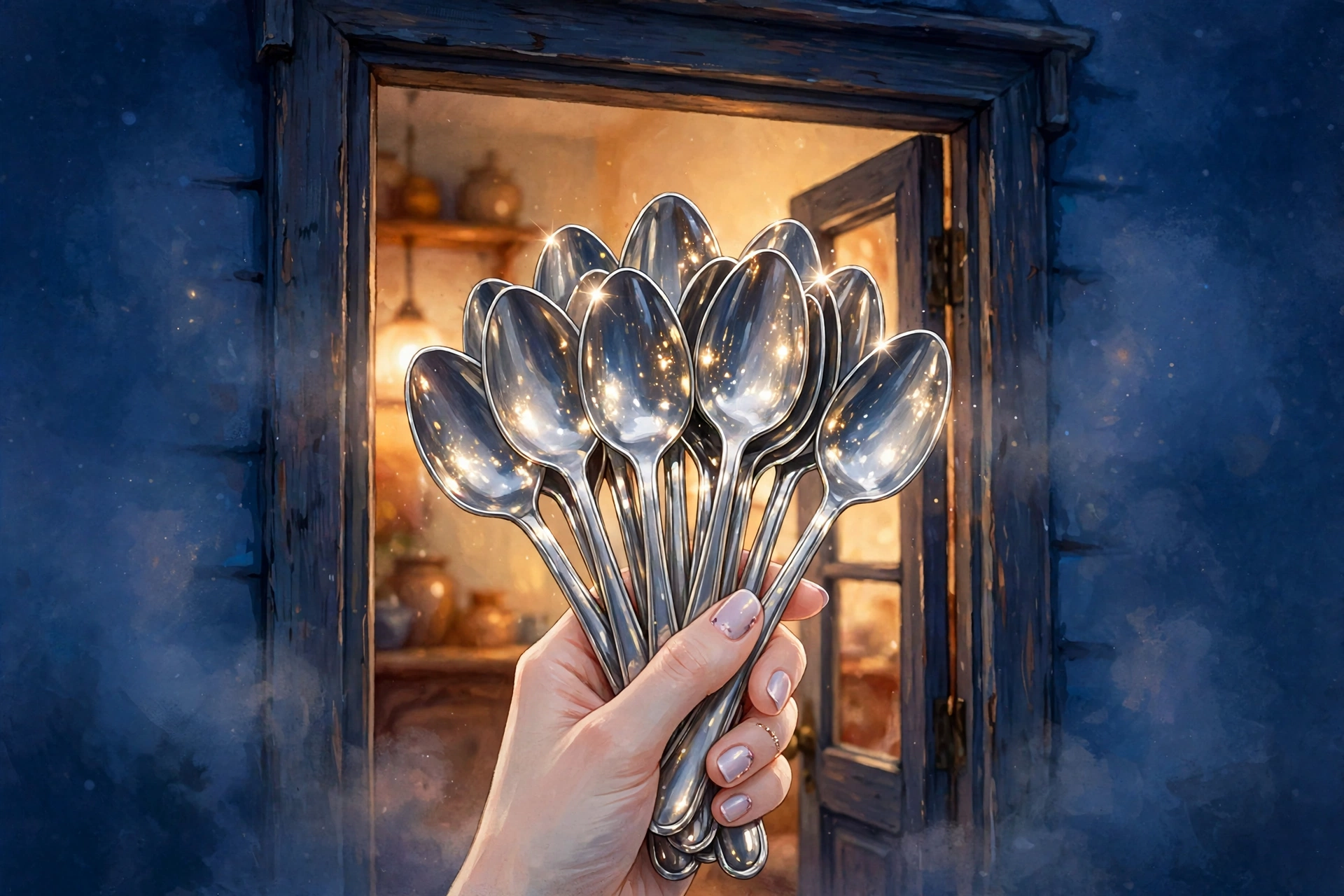
The bunch of spoons. She says she is taking everything back, and takes spoons. A bunch, not one spoon, and nothing else: no clothes, no furniture, no papers. Spoons feed people. They belong to kitchens, to servings, to the repeated small work of feeding a household. On a plain reading, the dream lets her reclaim the feeding layer of her home life and leaves the rest standing where it is. Would your list of what you would actually carry out be as short as hers, if you had to pick in one visit?
On the evidence: no direct study backs a fixed meaning for spoons in a dream. This reading comes from Bliss’s own sequence, where spoons are the single chosen item out of all her belongings, and from what spoons do in an ordinary kitchen.
The husband who never appears. He is named, blamed, and discussed, and he has no scene of his own. Both women talk about what the man is doing, and neither talks to him. In the dream’s own logic, that absence does work: the person at the center of the conflict is the only one who does not have to stand in the room and hear any of it. Our article on dreaming about an ex looks at a related staging, where a past partner shows up in person. Bliss’s dream makes the opposite choice, and the opposite choice is worth noticing.
The girlfriend begging. Bliss explains what the man is doing to her, and the girlfriend begs. The dream does not make the other woman smug or cruel. It makes her plead, which quietly reassigns the power in the room: the visitor who walked in uninvited ends up as the person being appealed to. Read plainly, that is the dream giving Bliss standing in a scene she entered at a disadvantage.
Talking and laughing together. The last turn is the one Bliss underlined herself, with her “even”: they were even talking and laughing together. A confrontation dream that ends in shared laughter has rehearsed something other than revenge. It has rehearsed the discovery that the other woman is a person in the same situation, hearing the same man’s story from the other side of it. Our case file on an ex who delivered the furniture home covers another dream where a rival figure and a household full of belongings end up in an unexpected arrangement.
On the evidence: no direct study backs a fixed meaning for laughter at the end of a confrontation dream. This reading comes from the sequence Bliss reported, where laughter follows the explanation and the begging, in that order, and from dreamer reports where a hostile scene softening is the detail the dreamer keeps returning to.
The question to sit with
Bliss walked into her husband’s girlfriend’s house to take her things back, and walked out, in effect, with a bunch of spoons and a laughing conversation. If you had one visit to that house, what is the one small, daily thing you would actually carry out, and what would you leave standing where it is?
Had a dream that stuck with you? Share it in our Facebook group. Not on Facebook? Drop your dream in the comments below. The most vivid ones get the full case-file treatment.
Prefer to listen? This series is also a podcast, Dream Case Files on Spotify: https://open.spotify.com/show/5TWggSlCTBsRYGsnpLJDDy
Leave a Reply