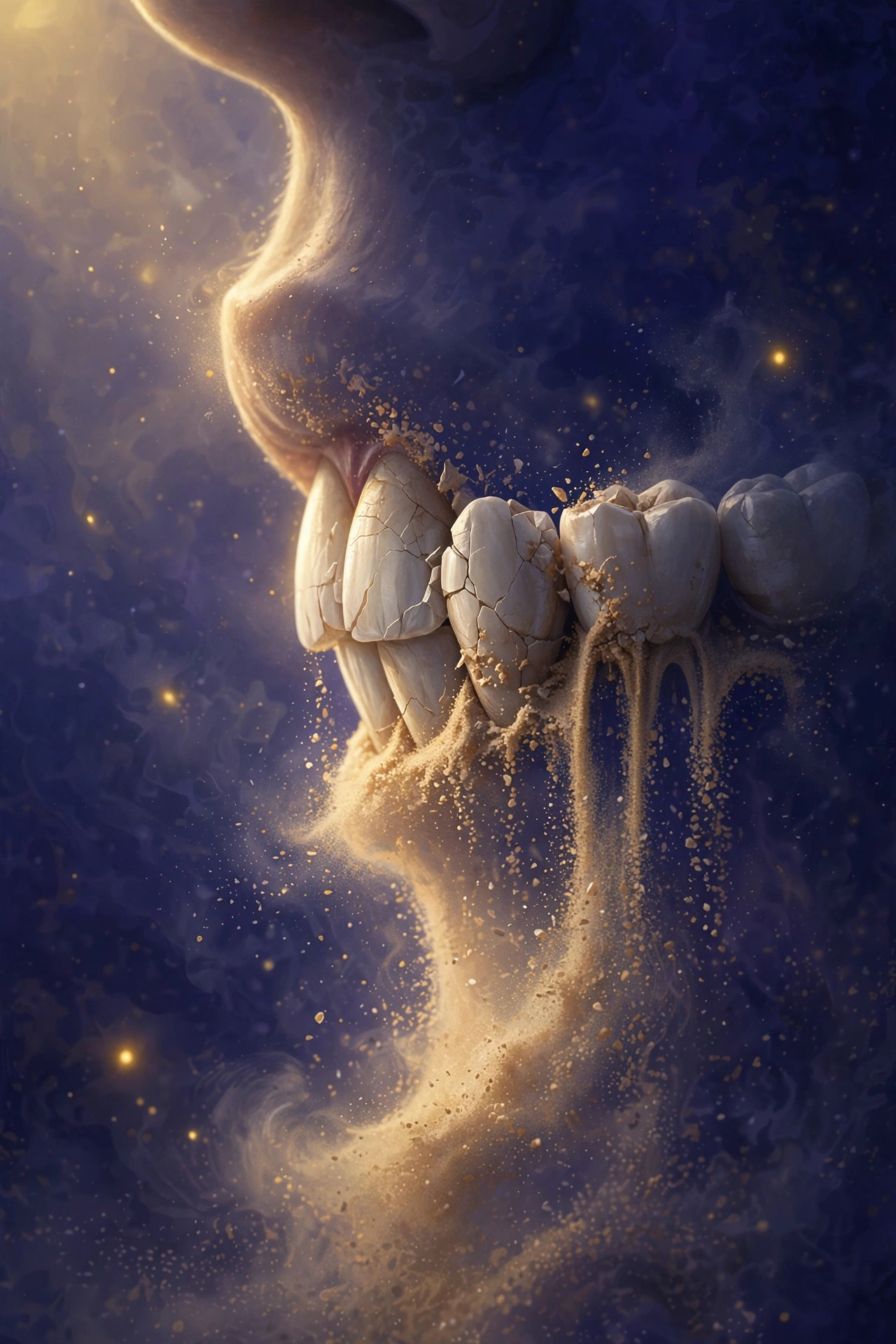
Teeth Falling Out Dream Meaning: What It Really Means
Interactive
Pull a card. See what your subconscious is saying.
Think of a recent dream, draw from a 12-symbol deck, and get a short reading. Free, no sign-up needed to play.
What It Means When You Dream About Teeth Falling Out
The short answer: Dreaming about your teeth falling out most often points to stress about losing control, worry about how other people see you, or a big change you did not choose. It is one of the most common stress dreams in the world, and it is almost never about your actual teeth. Which reading fits best depends on where life feels exposed or out of your hands right now.
You’re talking or smiling when a tooth loosens. Then another. You’re catching them in your hand, probing the gaps with your tongue, panic rising, until you wake up and run your tongue over your teeth to check they’re still there.
It’s one of the most commonly reported dreams in the world. And most people misread it. The dream is a spotlight, and your waking life is what it’s pointed at. The teeth are almost never the point. What the light lands on is.
Teeth going while something chases you is the double-pressure version: teeth falling out and being chased reads the pursuit and the exposure together.
When hair comes out in the same dream, the pair turns toward visible change and aging: teeth and hair falling out covers the mirror-dream combination.
If you arrived here from a Google search, there is a simple way to see more of our dream guides in your results: set DreamEvaluator as a preferred source on Google.
Test yourself: Think you can spot a teeth dream in three tries? The Daily Dream Game posts one short dream a day with four symbols to choose from.
Related reading: Teeth dreams land differently depending on who is dreaming, and three signs report them constantly. Compare your own sign’s version in Zodiac Dream Seasons.
Watch: the 60 second version
At a Glance
- It’s about a feeling. The teeth are just the costume this dream wears.
- The most common thread is loss of control: something in waking life feels like it’s happening to you rather than by you.
- Appearance anxiety and fear of embarrassment are frequent triggers. Teeth are how we present ourselves to the world.
- Big life transitions reliably spike these dreams: new jobs, moves, breakups, new babies.
On this page
- What It Means When You Dream About Teeth Falling Out
- Your Mind’s Favorite Metaphor for Losing Control
- The Appearance and Aging Connection
- Transitions: Why Big Changes Shake Your Teeth Loose
- The Words You Couldn’t Say
- Common Variations (And What Shifts)
- From the Community
- What to Do With This Dream
- Teeth in Our Community Count
- Teeth in Older Traditions
- Frequently Asked Questions
Teeth falling out is one of the 50.
Get the free guide when you join the DreamEvaluator mailing list. We send one confirmation email first, then your download.
Your Mind’s Favorite Metaphor for Losing Control
Ask a hundred people what their teeth dream felt like and you’ll hear the same words: helpless, exposed, unstoppable. You can’t push the teeth back in. You can’t stop the next one from loosening. Everyone can see it happening.
That is exactly what losing control feels like. Your dreaming mind thinks in images rather than sentences, so it reaches for the most visceral picture of “something essential falling apart” it can find.
Teeth are tools you use constantly: to eat, to speak, to face other humans. When they fail in a dream, the message is usually powerlessness in some waking situation. A project unraveling, a relationship shifting, finances wobbling. The situation doesn’t matter to the dream. The feeling does.
Ask yourself: where in my life do I feel insecure or unheard right now?
On the evidence: the one direct study complicates the popular reading, and this page prints that on purpose. Rozen and Soffer-Dudek (2018, Frontiers in Psychology) studied 210 people and found that teeth dreams tracked dental irritation, meaning tension felt in the teeth, gums, or jaw on waking, and did not track psychological distress. Grinding and stress travel together, so the body story and the control story can both be partly true. The honest grade: the physical explanation has the only direct study behind it.
The Appearance and Aging Connection
Teeth are also presentation. They’re among the first things people notice, and they’re tied, fairly or not, to youth and vitality. So these dreams often surface during spikes of self-consciousness: a milestone birthday, a visible sign of aging, a reunion, a job interview, any stage where you’ll be looked at and judged.
Feeling judged is its own kind of powerlessness. The verdict belongs to someone else. If your teeth dreams cluster around moments when you’re on display, that’s the thread to follow.
On the evidence: no direct study tests this reading. It rests on clinical observation and on a plain fact: teeth are presentation. They are what people see when you speak and smile, so dreams about them gather naturally around moments of feeling watched or judged. Treat it as a plausible reading, not a measured one.
Transitions: Why Big Changes Shake Your Teeth Loose
There’s a reason these dreams spike during life’s hinge moments. Starting a new job, moving house, marriage, divorce, becoming a parent, an empty nest, retirement. Losing teeth echoes one of childhood’s first rites of passage: the wobbly baby tooth, the gap-toothed grin, the small loss that meant you were growing up.
Your dreaming mind keeps that old template on file and reuses it at every new passage. Something is ending, something is beginning, and the in-between feels unstable. The dream is registering something simpler: the floor plan of your life just changed.
On the evidence: the pattern is widely reported by dreamers and clinicians, and it fits Domhoff’s continuity research, which shows dreams tracking the concerns of waking life. Big transitions are exactly the kind of concern that research would predict at night. No study has isolated teeth dreams in transition periods specifically, so the grade is supported pattern, unproven symbol.
The Words You Couldn’t Say
Because we speak with our mouths, teeth dreams sometimes carry a communication theme: the fear of saying the wrong thing, or the frustration of swallowing what you really feel. They often follow arguments you wish had gone differently, or stretches of holding back at work or at home.
Here the metaphor is blunt: my words are failing me. If you woke replaying a conversation, the dream may be pointing at the sentence you swallowed.
On the evidence: this reading comes from therapy rooms, not laboratories. No direct study backs it. It survives because dreamers keep recognizing themselves in it, especially the ones who woke up replaying a conversation. Hold it as a question worth asking, not an answer.
Common Variations (And What Shifts)
Teeth crumbling into gritty pieces
Crumbling suggests gradual erosion rather than sudden collapse. Slow-burn stress like burnout, or confidence wearing down a little each day. It didn’t happen overnight, and it won’t be fixed overnight either.
Teeth falling out one by one
A sequence of losses. Often tied to a chain of stressful events, one thing after another going wrong. Each tooth can represent a separate worry stacking up.
Spitting teeth into your hand
This one leans toward the communication theme. You’re expelling the teeth, pushing words out. It can reflect regret over something said, or anxiety about something you need to say but keep delivering awkwardly.
Rotting, blackened, or decaying teeth
Decay points to neglect. Not of dental hygiene, but of something in your life that needs attention. A friendship going quiet, a decision postponed, a checkup delayed. The dream shows you what “leaving it alone” looks like.
Your teeth growing back or being replaced
The hopeful one. Replacement teeth signal renewal. You’re coming through the transition and rebuilding. The dream is telling you the unstable part has an end.
Teeth falling out in front of other people
The audience changes the dream. Teeth lost alone, in front of a bathroom mirror, are mostly about control. Teeth lost mid sentence, in a meeting or in front of someone whose opinion matters, are about exposure: being seen mid failure with no way to tidy up first. Ask who was watching. The dream usually casts that role carefully.
Someone else’s teeth falling out
Sometimes the teeth are not yours. This version often reads as worry aimed outward: a parent aging, a child you cannot protect from everything, a partner in a rough stretch. It can also be a stand in, your own anxiety wearing someone else’s face because that is easier to look at. The feeling on waking, concern or horror, usually tells you which.
From the Community
A member wrote in that her teeth started coming out on their own, and she caught them in her hand as they fell. By the end of the dream her whole lower front row was gone. She woke up rattled and wanted to know what it meant.
Teeth dreams tend to show up when something in waking life has you feeling exposed or unsure of yourself, which is exactly the nerve this one hit.
Shared by a DreamEvaluator community member, lightly edited for anonymity.
What to Do With This Dream
- Name the dominant emotion. Panic? Shame? Helplessness? Sadness? The emotion is the truest part of the dream. Start there, not with the teeth.
- Scan your waking life for that same feeling. Be honest. The dream is usually pointing at the thing you’ve been avoiding.
- Find one small, controllable action. You can’t fix “my life feels out of control” in a day. But you can make the call, review the budget, book the appointment.
- Write the dream down. Dreams fade within minutes of waking. Three sentences in your phone preserves details your conscious mind would rather dismiss.
If the same dream keeps recurring, your mind is resending an unopened message. These dreams usually stop once the underlying pressure is addressed. That makes them a surprisingly useful early-warning system.
Go deeper
Teeth in Our Community Count
When we counted 247 real dreams posted in the group for State of Dreams, teeth falling out showed up 17 times. Cars and driving took first place at 73, which is why we say cars beat teeth four to one. The full tally is on the State of Dreams page.
Teeth in Older Traditions
Older dream traditions treated teeth dreams as messages about the household, not the self. They are worth knowing, and worth labeling honestly: this is folklore, some of it two thousand years old, not evidence.
Artemidorus and the household
In the Oneirocritica, his second century dream manual, the Greek writer Artemidorus mapped the teeth onto the dreamer’s household: lose a tooth, lose someone or something in the house. It is the oldest surviving teeth dream reading, and most later dream dictionaries borrowed from it, usually without saying so.
The Chinese saying
A saying passed down in Chinese families holds that dreaming of teeth falling out concerns the health of your parents. Grandmothers still quote it. Treat it the way you would treat any heirloom: with respect, and without mistaking it for a diagnosis or a prediction.
European folklore
In parts of Europe, a tooth loss dream was read as an omen of a death in the family. We do not read dreams as predictions, and our FAQ on this page explains why. The folklore still matters, because it explains some of the dread this dream carries into the bedroom.
Teeth as security
Some folk traditions read teeth as assets: hard, valuable, and meant to last. In that frame, a teeth dream can show up beside money stress, debt, or a job that feels less solid than it did last year. The dream turns a worry about security into something you can feel in your mouth.
On the evidence: the teeth and assets link is traditional symbolism, not a research finding. Money stress on its own is a well documented trigger for anxious dreams, so the pairing is plausible even though the symbol map is folklore.
Frequently Asked Questions
What does it mean when I dream about my teeth falling out?
It usually signals stress about control, appearance, or change: something in waking life feels like it is happening to you rather than by you. Teeth sit where speech, looks, and confidence meet, so the dream reaches for them when you feel exposed or unheard. If the dream keeps returning, the pressure behind it probably has not eased yet.
Is dreaming about teeth falling out bad?
No. It feels ominous, but it’s a stress signal. The dream typically reflects anxiety about control, appearance, or change. Think of it as a dashboard light for the present moment. It reports; it doesn’t predict.
What does it mean when your teeth crumble in a dream?
Crumbling often points to gradual erosion rather than sudden crisis: burnout, confidence wearing down over time, or slow-burn stress that built up unnoticed.
Why do I keep dreaming my teeth are falling out?
Recurring teeth dreams usually mean the underlying pressure hasn’t been resolved. The dream repeats because the feeling repeats. They often stop within weeks of addressing the real-world source.
Does dreaming of teeth falling out mean someone will die?
Some folk traditions say so, but there’s no evidence behind it. More likely: the dream follows real experiences of loss or grief, giving abstract pain a concrete image. It reflects how loss feels, not what will happen.
Keep Exploring
Decode the rest of your dreams
Your dreams use dozens of symbols every night. Teeth are only the beginning. The 50 Most Common Dream Symbols is free, and it decodes them in plain English in minutes.
Dream interpretation is for self-reflection and entertainment. It isn’t medical or psychological advice.