By Curtis West, founder of DreamEvaluator
Every dream site tells these stories the same way. A chemist dreams of a snake and solves benzene. A novelist dreams a monster and writes Frankenstein. The stories are good. Some of them are even true. The problem is that most retellings never ask the only question that matters: how do we actually know?
So this page grades them. Each dream below gets one of three marks, based on the evidence behind it rather than on how often it has been repeated. Documented means a first-person account from close to the event. Recollected means the dreamer told it themselves, but years later, when memory has had time to polish it. Legend means there is no primary source at all, and the tale grew in the telling.
Twelve dreams made the list. Two earned the top grade. Three are legends, including two of the most famous science dreams ever told. Check the grades before you repeat any of these stories as fact.
At a Glance
- Twelve famous dreams, each graded on the evidence behind it: Documented, Recollected, or Legend.
- Documented (2): Jack Nicklaus, who told a newspaper reporter within days, and Srinivasa Ramanujan, whose claim was recorded during his own lifetime.
- Recollected (7): Kekulé, Mary Shelley, Otto Loewi, Descartes, Paul McCartney, James Cameron, and Larry Page. All first person, all told years later.
- Legend (3): Elias Howe, Dmitri Mendeleev, and Niels Bohr. None of the three left the story in his own words.
- The pattern: the later the telling, the tidier the dream.
Kekulé and the Snake That Bit Its Tail
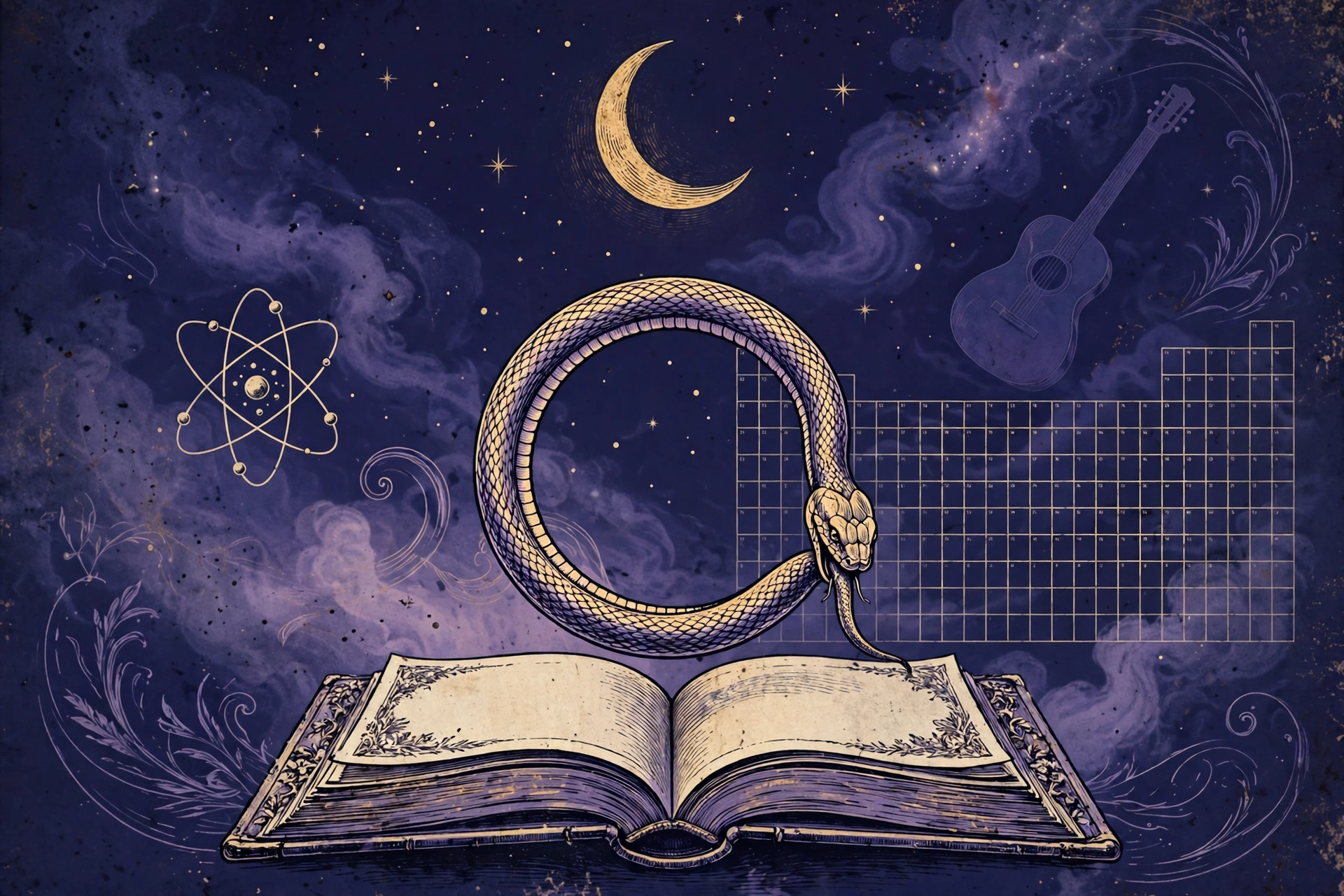
In the early 1860s, chemists knew benzene held six carbon atoms and six hydrogen atoms, but no chain structure they drew behaved the way benzene did. Friedrich August Kekulé, a German chemist working in Ghent, had wrestled with the problem for years. Dozing by his fire one night, he watched chains of atoms twist and writhe like snakes. One snake seized hold of its own tail and whirled in front of his eyes. He woke as if by a flash of lightning, spent the rest of the night working out the consequences, and published the ring structure in 1865. The snake that bites its own tail is still one of the most striking images in our guide to snake dreams.
Evidence grade: Recollected. Kekulé told the story himself, which helps, but he told it in 1890, at a festival held in his honor, 25 years after the night in question. Nothing written in the 1860s mentions it. Some historians suspect he borrowed the image from a parody pamphlet printed in 1886, which mocked his theory with a ring of monkeys holding on to each other. The benzene ring is solid science. The fireside snake rests on one speech, given late.
Mary Shelley and the Waking Dream That Built Frankenstein
In June 1816, in a villa on Lake Geneva, Lord Byron challenged his houseguests to write ghost stories. Mary Shelley, 18 years old, tried for days and came up with nothing. One night, after a long talk about galvanism and reanimating corpses, she lay awake with her eyes shut and saw a pale student kneeling beside a creature he had assembled, watching it stir into life. Then she saw the thing standing at her own bedside. She opened her eyes in terror. By morning she had the start of Frankenstein, published in 1818.
Evidence grade: Recollected. The account is Shelley’s own, which puts it ahead of most stories on this page, but she wrote it in 1831, fifteen years later, as the introduction to a new edition of the novel. She is also careful to call it a waking dream, not a dream in sleep, a distinction most retellings quietly drop. Her journals from that summer are missing, so nothing survives to check the story against, and by 1831 she had reason to shape her own origin myth.
Elias Howe and the Spears With Holes in Them
Elias Howe spent years failing to build a sewing machine that worked. The sticking point was the needle: every design copied the hand sewing needle, with the eye in the middle or at the blunt end, and the thread tangled. In the story his family told, Howe dreamed he was a prisoner of a king in a strange country, given 24 hours to finish his machine or die. The guards carried spears, and in the dream he noticed each spearhead was pierced near the tip. He woke at 4 in the morning, and by 9 he had whittled a model needle with the eye at the point, the one change his machine needed. His patent followed in 1846.
Evidence grade: Legend. Howe never told this dream himself, in anything that survives. The story appears in a 1900 history of his mother’s family, published decades after his death, and reference works that repeat it tend to flag it as possibly apocryphal. The patent is real, and the eye at the point was a genuine breakthrough. The dream that supposedly delivered it is a family story told when the one man who could confirm it was long gone.
Otto Loewi and the Experiment That Came Twice
Otto Loewi had spent years on a puzzle: do nerves signal the heart electrically, or chemically? The night before Easter, he woke with the design of an experiment that could settle it, scribbled it on a slip of paper, and went back to sleep. In the morning he could not read his own handwriting. The next night he woke at 3 AM with the idea again and went straight to his laboratory. He stimulated the nerve of one frog heart, took the fluid from around it, and put that fluid on a second heart. The second heart slowed. Nerves speak in chemicals. Loewi shared the Nobel Prize in 1936.
Evidence grade: Recollected. The source is Loewi’s own autobiographical sketch, written decades after the experiment was published in 1921. The experiment is documented and its result never in doubt. The midnight drama is less certain. His colleague Henry Dale remembered the episode differently, and historians have noted that Loewi was a fine storyteller who likely polished the night into a better shape than the one it happened in.
Ramanujan and the Goddess Who Wrote on His Tongue
Srinivasa Ramanujan, a clerk in Madras with little formal training, filled notebooks with thousands of mathematical formulas, many of them deep results with no proof attached. He said they came from Namagiri, his family goddess, who appeared in his dreams, wrote equations on his tongue, and showed him scrolls of work. He kept a slate by his bed and woke to record what he had been given. When his mother dreamed that the goddess told her not to stand in her son’s way, the family let him sail for Cambridge in 1914, to work with G. H. Hardy.
Evidence grade: Documented, for the claim itself. Ramanujan credited Namagiri openly, repeatedly, and during his own lifetime. The people around him recorded it at the time, and Robert Kanigel’s standard biography lays out that record. The notebooks he filled are real objects. Whether a goddess actually handed him the mathematics is not a question any evidence can settle, and this grade does not pretend otherwise. It marks that the attribution was truly his, made while he lived, not a legend pasted onto him after his death.
Descartes and the Three Dreams of 1619
On November 10, 1619, René Descartes, a 23 year old soldier and scholar in winter quarters on the Danube, spent the day thinking alone in a stove heated room. That night came three dreams. In the first, a fierce wind spun him around and bent him double as he struggled toward a chapel, weak on his right side. In the second, a crash like thunder filled his room with sparks. In the third, he found a dictionary and a book of poems on his table, opened at the line: What road of life shall I follow? He took the night as confirmation of the philosophy he spent his life building. Wind and thunder carrying that much weight in a single night is familiar ground; our page on storm dreams looks at why the dreaming mind reaches for weather.
Evidence grade: Recollected, and the softest in that class. Descartes wrote the dreams down in a private notebook at the time, but the notebook is lost. Everything known about them comes from Adrien Baillet’s biography, published in 1691, seventy two years after the night, which claims to paraphrase those notes. Baillet may be faithful. There is no original left to check him against, and honest retellings should say so.
Paul McCartney and the Melody on Wimpole Street
Paul McCartney was staying at his girlfriend Jane Asher’s family home on Wimpole Street in London when he woke one morning with a complete melody running in his head. He fell out of bed, sat down at the piano beside it, and played the tune through, fairly sure it must belong to somebody else. For weeks he played it to John Lennon, to George Martin, to anyone who would listen, asking whether they recognized it. Nobody did. It carried joke lyrics about scrambled eggs until the real words arrived, and in 1965 it was released as Yesterday.
Evidence grade: Recollected. McCartney has told this story himself for sixty years, in his authorized biography and in many interviews, and the details barely shift between tellings, which counts for something. But the earliest tellings still came years after the night, sources disagree on whether it was 1963 or 1964, and the only witness was the man who woke up owning one of the most covered songs in pop history. Consistent is not the same as documented.
James Cameron and the Chrome Skeleton in the Fire
In 1981, James Cameron was in Rome finishing a low budget horror film, Piranha II, broke, ill, and running a fever. In a fever dream he saw a chrome skeleton, all metal frame and no flesh, dragging itself out of fire and crawling toward him. He woke and sketched it on hotel stationery. In 1984 the image reached the screen in The Terminator, and the crawling skeleton, still coming after everything thrown at it, became the climax of the film. Readers of our guide to being chased in a dream will know that shape well: a pursuer that cannot be argued with, tired out, or escaped.
Evidence grade: Recollected. Cameron tells the story himself, most fully in a 2021 interview with the British Film Institute, forty years after the fever. The film matches his description closely. But the hotel sketch has never been produced with a date on it, so the dream itself rests on the word of its director, given four decades later.
Larry Page and Downloading the Whole Web
Larry Page was a 23 year old Stanford graduate student when he woke in the night with a question fully formed: what if we could download the whole web, and just keep the links? He scribbled the technical workings in the dark, then told his advisor, Terry Winograd, that the project would take a couple of weeks. It took longer. Ranking web pages by the links pointing at them became his research project, then PageRank, and in 1998 Page and Sergey Brin built Google on the strength of it.
Evidence grade: Recollected. Page told the story in his own words in a commencement speech at the University of Michigan in 2009, thirteen years after the dream. One detail argues in his favor: he is quick to say the dream gave him no thought of building a search engine, and that the search idea came later, from the work. People polishing a legend usually claim more foresight than that, not less.
Jack Nicklaus and the Grip He Found Asleep
In June 1964, Jack Nicklaus was 24 years old and, by his own high standards, in a slump. One Wednesday night he dreamed he was swinging beautifully, and noticed he was holding the club differently from the grip he had lately drifted into. The next morning he tried the dream grip on the practice ground. It worked at once. He shot 68 on Thursday and 65 on Friday, and admitted afterward that he felt kind of foolish saying so, but all he had done was change his grip just a little, in a dream.
Evidence grade: Documented. This is the cleanest file on the page. Nicklaus told the story to a San Francisco Chronicle reporter within days of the dream, and it ran in print on June 27, 1964, in the first person, while the rounds he described could still be checked in any newspaper. The quote was later reprinted in William Dement’s 1972 book about sleep. No decades of retelling, no memoir written after the fact. Just a young golfer telling a reporter something he knew sounded odd.
Mendeleev and the Periodic Table That Probably Was Not a Dream
The most repeated dream in science says that Dmitri Mendeleev, stuck for days on arranging the chemical elements, fell asleep and saw the periodic table complete in a dream, every element in its place. The quote attached to it is perfect: I saw in a dream a table where all the elements fell into place as required. Awake, the story says, he wrote it down and had to correct only one detail.
Evidence grade: Legend. Mendeleev never made this claim. The quote traces back to a colleague, Alexander Inostrantsev, in a memoir published after Mendeleev’s death, some forty years after 1869. The paper trail argues against it too: worksheets dated February 17, 1869 show Mendeleev sorting the elements on cards step by step, and he kept revising the table for two more years, which is not how a finished table arrives. Michael Gordin, a Princeton historian who has read the sources, gives his verdict plainly: he does not believe it.
Niels Bohr and the Atom Dream Nobody Can Source
The story says Niels Bohr dreamed the atom: a nucleus like the sun, electrons as planets held on thin threads, and woke knowing the structure. His 1913 model really did set electrons in orbits around a nucleus, and it changed physics. A leap that size attracts an origin story, and a dream is the most dramatic origin there is, which is why this one gets copied so faithfully.
Evidence grade: Legend. No letter, diary, paper, or interview has Bohr mentioning any such dream. The tale surfaces in popular dream books of the 1970s and has been passed from one to the next ever since. The documented route is plainer: Ernest Rutherford’s group already had the planetary atom by 1911, and Bohr’s real contribution was adding the quantum rules that kept the electrons in their orbits. That took sustained hard thought, not a vision in the night.
The same evidence habit runs through the rest of this site. Our State of Dreams report counts what our own community actually dreams about, symbol by symbol. The Dream Case Files publish members’ dreams the same way this page treats the famous ones: the dreamer’s own words first, the grading after.
Free: The 50 Most Common Dream Symbols Guide
Get the free guide when you join the DreamEvaluator mailing list.
Share Your Own Dream
Every dream on this page survived because somebody wrote it down or said it out loud while it was still fresh. If one of yours has stayed with you, post it in the DreamEvaluator Facebook group, where members share their dreams and work through them together. Your evidence grade starts at Documented: first person, same week, no polishing required.
For the symbols themselves, our free guide to the 50 most common dream symbols covers the images that turn up again and again: snakes, storms, chases, teeth and the rest. It is free, and it takes about ten minutes to read.
Leave a Reply