About Dream Case Files
Every week we take a real dream shared by a member of our Facebook community and give it the full treatment: the dream in their words, what it may mean, and a symbol-by-symbol breakdown. No generic definitions. Real dreams, real people.
The dream, shared by Brooke in our Facebook group (lightly edited for readability):
I was in my room in my bed, and the door opened, and something came in. I don’t know what it was, but I knew it was evil, and I tried to scream, but I could not make any noise. Then, in my dream, I woke up. About the time I started to calm down, thinking it was only a dream, the door would open again, and everything would begin again. After several loops like this, in between which I would actually wake up, I decided to give myself an indicator that would tell me if I was really awake, or just dreaming that I was awake. I lit a candle in my attached bathroom. That way, if I thought I was awake, I could look for the candle and I would know for sure. I went back to sleep and the loop started again. The door opened, something came towards me, I tried to scream, but I could not make any noise. Then again, in my dream I woke up. But this time I was lucid enough to tell myself to look for the candle. When I did not see the candle, I realized I was still asleep, and I forced myself to actually wake up. I’m exhausted today. This felt like a spiritual attack to me. My muscles are so sore, as if I physically fought something all night. Does anyone have any input?
Key takeaways
- The same scene restarts each time Brooke thinks she has woken up.
- She tries to scream in every loop and makes no sound.
- The candle is her own invention, a test she sets while she is awake.
- The loop breaks when the candle is missing, not when the presence leaves.
The 50 dream symbols readers ask about most, in one free guide.
Get The 50 Most Common Dream Symbols, our free quick-reference guide, in plain English. We send one confirmation email first, then your download.
What this dream may be working through
Start with a plain boundary. This article reads the dream symbolically. The presence Brooke sensed in her room is read here as dream imagery, not as evidence of a real visitor, a warning, or anything that happened outside her sleep. That boundary matters because the dream felt physical to her. She woke tired and sore, and she said so plainly.
The loop is the structure to notice first. Brooke does not dream one long chase. She dreams a short scene, wakes inside the dream, calms herself, and then watches the door open again. Relief becomes part of the cycle. Each false waking teaches her that waking up cannot be trusted, which is why the night felt longer than one nightmare. Our guide to recurring dreams covers dreams that return across nights. Brooke had the return compressed into a single night, minutes apart.
On the evidence: this reading follows the continuity idea linked to G. William Domhoff, that dream content tends to track waking concerns. A bedroom that stops feeling safe, and a voice that will not work when she needs it, fit a waking question about control at home better than they fit a claim about an outside presence.
On the evidence: false awakenings, waking up inside a dream and believing it is real, are a documented dream type in sleep research, and lucid dreamers have long used reality checks to test them. Stephen LaBerge and the lucid dreaming research tradition described checking a stable detail in the scene to tell dreaming from waking. Brooke built her own version of that check with a candle, without naming it as a technique.
The candle changes the dream because it gives her a fact to look for. Before the candle, she has only a feeling to argue with, and the feeling loses each time the door opens. After the candle, she has a yes or no question: is the flame in the bathroom or is it not? When the answer is no, she acts on it and wakes herself. The useful detail is not that a candle is magic. It is that she stopped trying to win the scary scene and tested the scene itself.
On the evidence: Antti Revonsuo’s threat simulation theory proposes that dreaming can rehearse threatening events. A repeated approach toward a bed, with the dreamer unable to call out, fits that rehearsal shape. The theory does not prove why Brooke had this dream on this night, and this article does not use it that way.
Brooke described the night as a spiritual attack. That reading belongs in this file, after the psychological one, and labeled for what it is. In many faith and folk traditions, a heavy presence in a bedroom at night is read as a spiritual visit or attack, and people respond with prayer or protective rituals. That is tradition, passed through families and faith communities, not a finding from a study. Readers who hold that tradition will recognize Brooke’s wording at once. Readers who do not can still follow what the dream put her through, loop after loop, in her own bed.
The symbols, one by one
The bedroom door opening. The door is the boundary of the most private room in the house, and in this dream it opens on its own schedule. Brooke is already in bed each time. She does not go looking for trouble. Trouble arrives at the threshold and crosses it, which is a specific kind of helplessness worth naming before any broader reading.
The unseen presence. Brooke never describes a face or a shape. She knows something came in, and she knows how it felt. An unnamed threat lets the fear stay general, which may be why the scene could restart so cleanly. Our guide to nightmares looks at how a dream can keep its force even when the threat stays vague.
On the evidence: no direct study backs a fixed meaning for an unseen presence entering a bedroom in a dream. This reading comes from Brooke’s own sequence, a presence felt rather than seen, and from dreamer reports where the feeling arrives before any image does.
Trying to scream with no sound. This is the detail Brooke repeats in every loop. She tries, and nothing comes out. In her telling, the lost voice is not a side detail. It is the moment each loop turns, because she cannot call for help and cannot scare the presence off. What in waking life has left her trying to speak up and feeling unheard?
The false waking. Each time Brooke wakes inside the dream, she does the sensible thing. She calms down and tells herself it was only a dream. The dream uses that sensible moment against her, because the door opens right after it. A false waking steals the one reward a nightmare is supposed to give, which is the relief of being awake.
On the evidence: in our State of Dreams counts, houses and rooms appear often in the dreams we counted, though we do not publish a separate count for false awakenings, so we do not put a number on this one. The claim here rests on Brooke’s own count of several loops in one night.
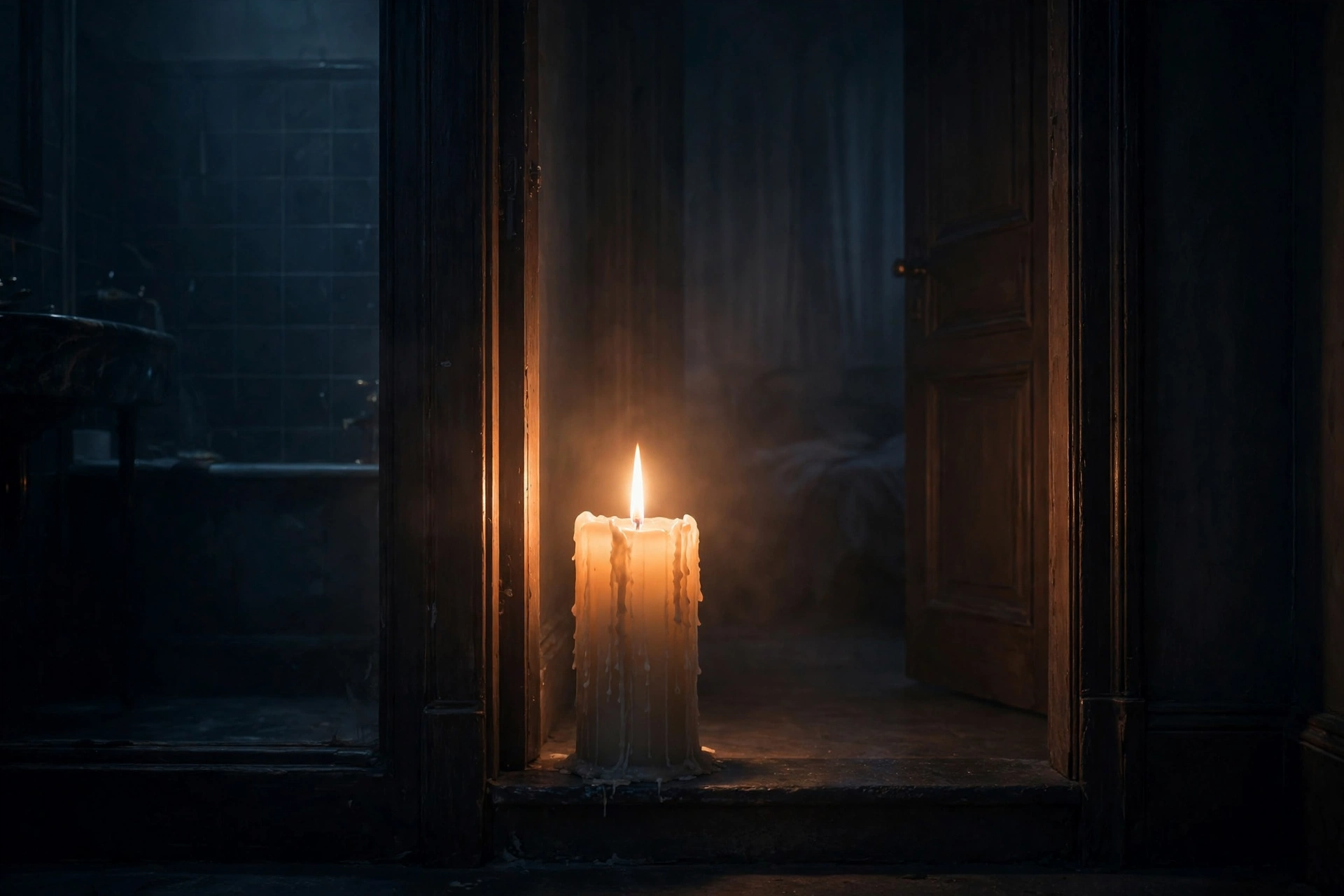
The candle in the bathroom. Brooke lights it while she is awake, in the room attached to her bedroom, and gives it one job. It is not decoration and it is not a ward. It is a marker. If the candle is there, she is awake. If it is not, she is still dreaming. Our explainer on whether lucid dreams are dangerous looks at the line between noticing you are dreaming and trying to control the dream. Brooke stays on the noticing side, and noticing is enough.
On the evidence: no direct study backs a fixed meaning for a candle in a dream. This reading comes from the job Brooke assigned the candle in her own account, and from the reality check tradition in lucid dreaming practice, where a chosen detail is tested on purpose.
Waking exhausted, with sore muscles. Brooke ends her post with her body, not with the presence. She is exhausted, and her muscles are sore as if she fought something all night. This article does not explain that soreness, because dream interpretation cannot. What it can record is the order she chose: loop, candle, waking, and then a body that felt like it had been through the night she described. If broken nights like this keep happening, that pattern is worth raising with her doctor, in plain terms, with the loop described exactly as she described it here.
The question to sit with
Brooke, when the door opened again after you had calmed down, what in your waking life has been restarting just as you start to feel settled?
Had a dream that stuck with you? Share it in our Facebook group. Not on Facebook? Drop your dream in the comments below. The most vivid ones get the full case-file treatment.
Prefer to listen? This series is also a podcast, Dream Case Files on Spotify: https://open.spotify.com/show/5TWggSlCTBsRYGsnpLJDDy
Leave a Reply