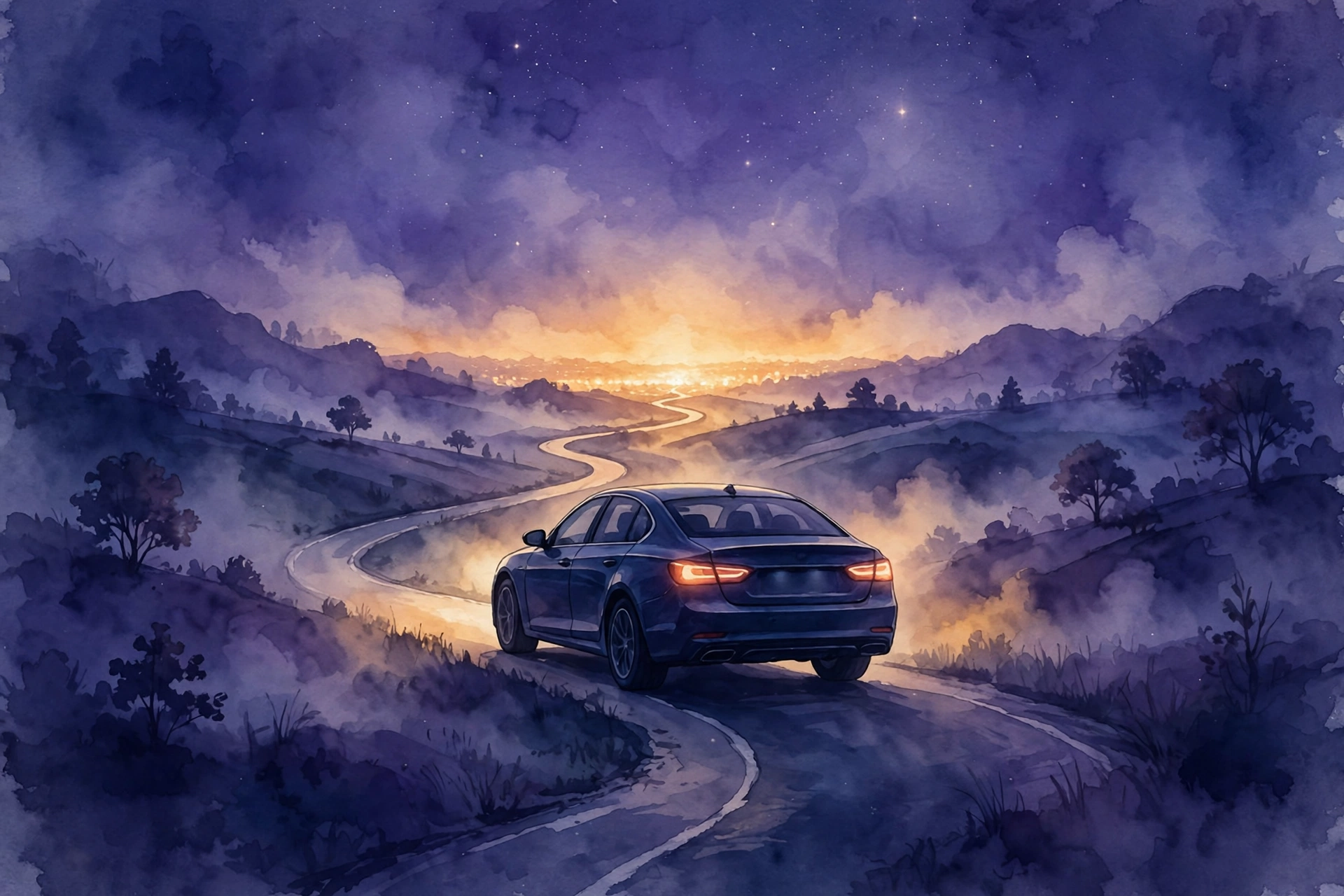
You are on a road you know by heart, hands at ten and two, when you notice the car is not doing what you tell it. The wheel turns. The car keeps going straight. Or the road is clear, the tank is full, and you wake up calm in a way you have not felt for weeks. Driving dreams stick because the feeling stays in your hands.
Most adults drive almost every day. So the dreaming mind borrows the car for a bigger job: talking about direction, and how much say you think you have over where things are headed.
The Short Answer
Driving a car in a dream usually points to control and direction in your waking life. A smooth drive tends to match a stretch where you trust your own choices. Trouble with brakes, steering, or the road tends to match a situation that feels hard to slow down or hard to guide. Who is in the car matters too. A dream where someone else drives says something different from a dream where you drive alone. Much like being lost in a dream, a car that will not start points at feeling stuck.
In our State of Dreams count, cars, driving, and roads showed up 73 times. That was the highest count in the report.
At a Glance
- The car stands for direction: where your life is headed and how you are getting there.
- Your seat is the first clue: driver, passenger, and back seat carry different levels of say.
- Car trouble points at control trouble: brakes, steering, and a car that will not start each name a different worry.
- Passengers name the relationship: who rides with you, and who you trust at the wheel.
Free: The 50 Most Common Dream Symbols Guide
Get the free guide when you join the DreamEvaluator mailing list.
6 Interpretations of Driving a Car in a Dream
1. You feel in control of where your life is going
Start with the plain version. You drive well. The road is open, the car answers the wheel, and you know where you are going. Dreamers often report this version when a plan is working. A job change that landed. A move that finally happened. The dream reports that your hands and the road agree.
On the evidence: G. William Domhoff’s continuity research found that dream content tracks waking concerns in a regular way. No study isolates smooth driving dreams, so this reading rests on continuity plus dreamer reports.
2. Something in your life feels hard to slow down
The brakes go soft. You press harder and the car rolls on. This version tends to arrive when a commitment has picked up speed of its own: a project with a date you did not set, a family obligation that keeps growing. You are still at the wheel. You just cannot set the pace.
On the evidence: no direct study tests brake failure in dreams. The reading comes from dreamer reports and clinical practice. Treat it as a prompt to name the fast thing, not as a warning about your real car.
3. You are in the passenger seat of your own life
Someone else drives. You watch the road from the wrong seat. Sometimes that feels restful. Sometimes you want to grab the wheel and cannot. The feeling decides the reading. A trusted driver can stand for a person you are happy to follow. A reckless driver often points at a decision about your life that someone else keeps making.
On the evidence: this reading comes from dream dictionary tradition and dreamer reports. No study tests the passenger seat reading directly.
4. A decision you have been putting off is back on the dash
Some driving dreams loop. Same junction. Same turn you almost take. Readers who get this version can often name the choice at once while awake. The application saved as a draft. The talk you keep rehearsing. The dream keeps driving you back to the junction because the turn is still there.
On the evidence: no study backs this reading. It comes from dreamers who report the loop faded after they made, or honestly dropped, the decision they had been circling. That is not proof.
5. The road conditions show how supported you feel
Rain. Ice. A road full of holes. Weather and road surface add a second layer to the control reading. A bad road with a car that still handles well can mean you trust yourself in hard conditions. A good road and a car that falls apart points the other way. The trouble sits in the vehicle, not the world. Winter versions sit close to snow and ice dreams, where grip is the whole question.
On the evidence: the road surface reading comes from clinical practice and dreamer reports, with no direct test behind it.
6. Who rides with you names what the trip is about
A partner in the front seat. Kids in the back. A workmate giving directions. Passengers turn a control dream into a relationship dream. Ask who you were carrying, and whether they helped, argued, or slept. Dreamers often find the passenger was the point all along. A full car also touches house and rooms dreams, where the people inside a space define what it means.
On the evidence: social interaction is a central feature of ordinary dreaming in Domhoff’s dream report research. The passenger readings come from dreamer reports and clinical practice.
Common Variations and What Changes the Meaning
The brakes fail, or the car will not stop
Speed is the subject here. Read it for the part of life moving faster than you can manage: work picking up pace, a relationship rushing ahead, a schedule with no gaps. If the car stops in time, note that too.
You are driving from the back seat
You can see the road. Your hands barely reach the wheel. This setup shows up in reports from people who hold formal responsibility while real control sits elsewhere. A manager in name. A parent whose teenager now sets the household weather.
Someone else is driving and you feel unsafe
A stranger at the wheel differs from a partner at the wheel. A stranger often stands for forces with no face: an employer, a market, a medical process. A known person points at that relationship. If you asked them to slow down and they laughed, write that line down.
You get lost, or the road runs out
Streets repeat. Or the paved road gives out into dirt, then into nothing. This version leans toward direction over control. You can drive fine. You no longer trust the destination, or the map you were handed. It sits close to being late in a dream when a deadline waits at the end of the road.
The car will not start, or keeps stalling
You turn the key and get a click. Or the car starts, moves a few yards, and dies at every light. Read this one for stalled starts in waking life. A plan that begins and stops. Energy that runs out by Tuesday.
Driving in rain, at night, or on ice
Rain and night point at a stretch where you must move ahead with poor information. Ice removes grip, so care beats speed, a cousin of the weather in storm dreams. If you slowed down and felt steadier, copy that while awake.
You crash, or you nearly crash
A crash dream frightens people out of proportion to what it usually reports. In most reports it marks a clash that already happened in words, or a fear that two parts of life are about to collide. Work hours against family hours is the classic pair. A near miss carries a different tone.
On the evidence: Antti Revonsuo’s threat simulation theory holds that the dreaming brain rehearses danger so the dreamer can practise a response. Crash dreams fit that frame. The theory does not turn one into a prediction.
What Older Dream Books Said
Psychological readings come first. The material below is older tradition, not evidence.
Dream dictionary tradition
Older dream books had no cars, so they read carts, carriages, and horses in the same slot: the vehicle stood for the dreamer’s course through life, and a runaway horse got the reading a runaway car gets now. Keep the useful scrap. The vehicle is the course, and the driver is the question.
What to Ask Yourself After This Dream
- Where was I sitting? Your seat is the fastest guide to how much say you feel you have.
- What went wrong first? Brakes, steering, engine, or road. Each names a different trouble.
- Who was in the car? Name every passenger and what they did.
- Did I know where I was going? A broken car with a clear destination reads differently from a good car with none.
- What in my week is moving at that speed? Name one concrete thing.
Frequently Asked Questions
What does it mean when you dream about driving a car?
It usually points to direction and control in waking life. A smooth drive tends to match a stretch where you trust your choices. Trouble with the car tends to match a situation that feels hard to guide or slow down. Your seat, passengers, and road fill in the rest.
Why do I keep dreaming my brakes do not work?
Repeat brake dreams usually track a repeat feeling: something keeps gaining speed while your say in it stays the same. Work pace and family obligations lead the reports we see. Track the weeks when it returns.
What if someone else is driving in my dream?
Read the driver first. A trusted person can stand for a stretch where you are content to be led. A careless driver often points at a decision you feel someone else controls. Your feeling in the seat settles which reading fits.
Is a car crash dream a warning?
No. A crash dream reports pressure or a clash you already sense. It does not predict a real crash. People anxious about a real trip, or a new teen driver at home, get this dream often. The worry is the subject.
Want the Full Picture?
Want the full picture? Grab the free 50 Dream Symbols Guide at https://dreamevaluator.com/free-dream-symbols-guide/ and it comes free when you join the mailing list.
Get the free guide when you join the DreamEvaluator mailing list.
Prefer to listen? Dream Case Files, our podcast, gives real member dreams the full treatment every week: https://open.spotify.com/show/5TWggSlCTBsRYGsnpLJDDy
Dream interpretation is for self-reflection and entertainment, not medical or psychological advice.
Leave a Reply