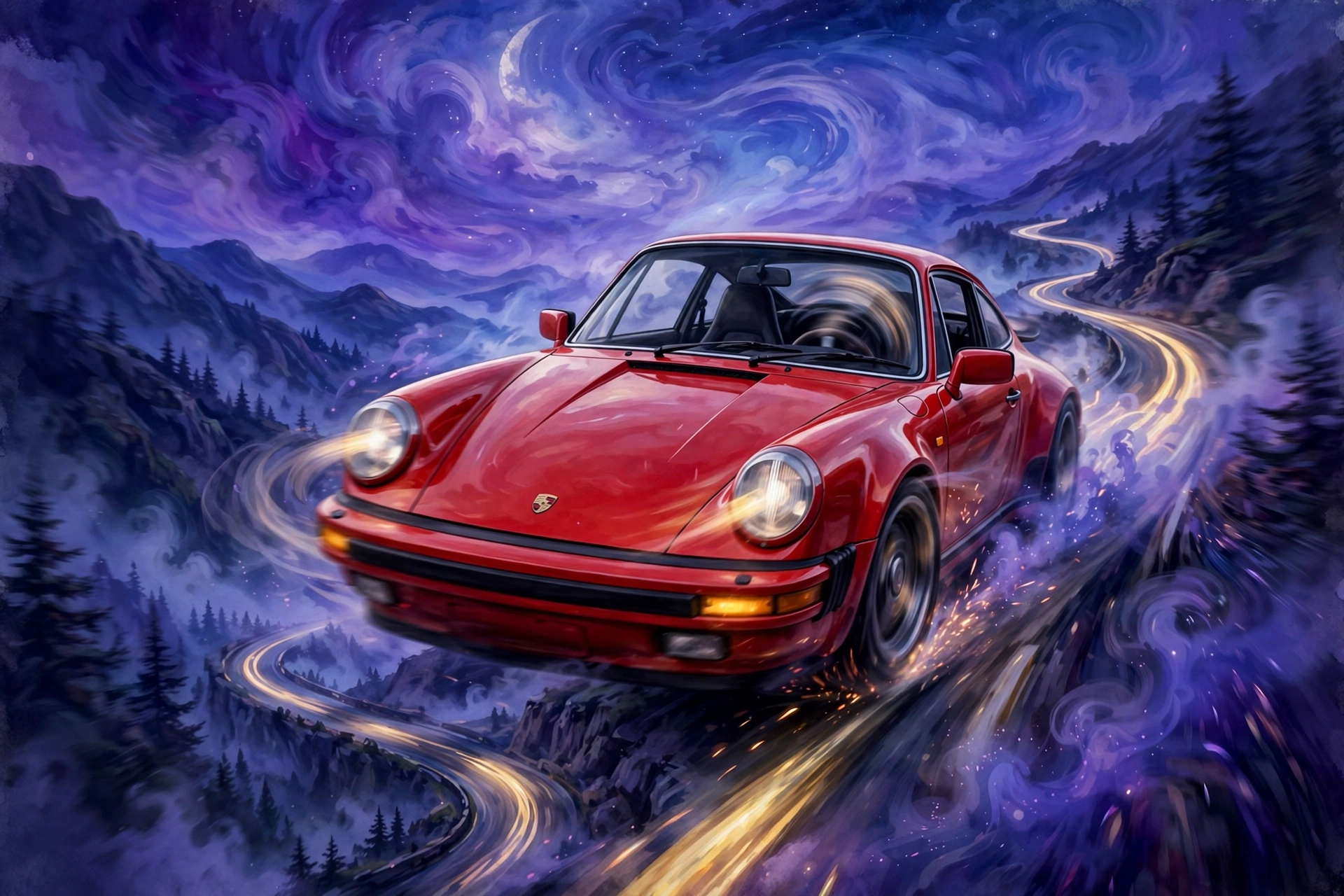
The brakes are gone. You press the pedal to the floor and the car keeps rolling, picking up speed on a road that suddenly has too many turns. Or there is no driver at all, and you watch from the back seat while the car steers itself. You wake up with your heart going, foot still pushing at the mattress.
This is the louder cousin of an ordinary driving dream. A normal car dream asks who is in charge of your direction. This one asks what happens when the charge is gone. Compare it with driving a car in a dream
The Short Answer
An out-of-control car in a dream usually points to one part of waking life that is moving faster than you can steer it. Work leads the reports. A relationship rushing ahead comes second. The detail that failed first is the best clue. Dead brakes point at pace. A loose steering wheel points at direction. An empty driver seat points at a situation nobody seems to be running. The dream rarely covers your whole life. It tends to pick one fast thing and put you inside it.
In our State of Dreams count, cars, driving, and roads showed up 73 times. That was the highest count in the report.
At a Glance
- Speed is the subject: something in waking life is moving faster than you can manage.
- The failed part names the worry: brakes mean pace, steering means direction, an empty seat means nobody is in charge.
- Your seat matters: fighting the wheel feels different from watching from the back.
- It picks one thing: most dreamers can name the fast situation within a minute of waking.
Free: The 50 Most Common Dream Symbols Guide
Get the free guide when you join the DreamEvaluator mailing list.
6 Interpretations of an Out-of-Control Car in a Dream
1. One situation is moving faster than you can steer it
Start here, because most reports land here. A project picked up a deadline you did not choose. A house sale is closing before you feel ready. The car does what the situation does in daylight. It moves at its own speed while you hold on. Ask which single thing in your week has a pace set by someone else, rather than by you.
On the evidence: G. William Domhoff’s continuity research found that dream content tracks waking concerns in a regular way. No study isolates runaway car dreams, so this reading rests on continuity plus a large pile of dreamer reports.
2. You can see where things are headed and cannot change the course
The brakes work fine here. The steering does not. You watch the bend coming and the car will not turn. Dreamers link it to a slow, visible problem: a budget sliding month by month, a parent’s health, a team drifting toward a layoff everyone can sense. The dread comes from watching it approach with your hands on a wheel that does nothing.
On the evidence: no direct study tests failed steering in dreams. The reading comes from dreamer reports and clinical practice, where the image is read as a picture of low control over a known outcome.
3. Nobody is driving, and that is the point
The empty seat version unsettles people more than a crash does. The car moves through traffic with no hands on the wheel while you scramble from the back seat. Readers tie it to places running on autopilot: a family where no adult has taken charge of a hard decision, a job where the person meant to lead has checked out. The fear is not speed. It is the vacancy.
On the evidence: this reading comes from dream dictionary tradition and dreamer reports. No research tests the empty seat image on its own.
4. A habit or urge feels stronger than your brakes
Sometimes the car stands for the dreamer’s own behavior. Late night spending. Snapping at a partner and hearing the words land too late. A drinking or scrolling habit that starts small and gathers speed. In these reports the dreamer knows the car is them. The brakes are the promise they made to themselves, and the dream shows it failing at the moment it matters.
On the evidence: no study backs this specific reading. It comes from clinical practice, where dreamers themselves often supply the link once they describe the dream out loud.
5. You are carrying passengers you feel responsible for
Kids in the back. A partner gripping the door. A parent in the front seat. Passengers shift the dream from control to responsibility. Dreamers who support a family report this version when money or caregiving feels thin. The terror is not crashing. It is failing the people in the car with you. It sits near being late in a dream
On the evidence: social figures appear in most dream reports in Domhoff’s research. The responsibility reading comes from dreamer reports, not a direct test.
6. Your body is simply rehearsing danger
Not every runaway car carries a message. Some are pure rehearsal. The dreaming brain builds a threat, drops you into it, and lets you practice grabbing, swerving, and bracing. People report these after near misses on real roads, or during anxious stretches when threat dreams spike, including storm dreams and chase dreams.
On the evidence: Antti Revonsuo’s threat simulation theory proposes that dreams rehearse dangerous events so the dreamer can practice responding. Runaway car dreams fit that frame well. The theory explains the rehearsal. It does not make the dream a prediction about your car.
Common Variations and What Changes the Meaning
The brakes fail completely
Pace is the whole story here. You had a plan to slow down and the plan did nothing. Read it against the commitment that keeps accelerating: overtime that became permanent, a course load, a renovation. If pumping the brakes worked a little, note that. Partial brakes match a situation where you have some say, just less than you want.
The steering wheel spins free or comes off in your hands
Direction, not speed, is broken here. The car rolls at a normal pace toward the wrong place. Dreamers link it to going along with a plan they never chose: a career track set in motion years ago, a wedding, a move. If the wheel worked, where would you turn?
There is no driver and you are in the back seat
You can see the road and reach nothing. This shows up when a situation that affects you is being run, badly or not at all, by others. A landlord, a committee, an ex with a lawyer. Climbing into the front seat inside the dream usually tracks taking one real step toward the problem while awake.
The car speeds up downhill and will not slow
A hill adds gravity. Things are not just fast. They feed on their own momentum. Debt works like this. So does a feud, and a workload where each finished task spawns two more. This version pairs often with falling in a dream. The shared feeling is the giveaway: descent you did not choose.
Someone else is driving too fast and will not listen
A partner, a parent, a boss at the wheel, laughing off your requests to slow down. This one points at a named relationship. Keep the detail of what you did. Did you shout, go quiet, or reach for the door? Dreamers say the answer matches how they handle that person in daylight.
You crash, or you stop the car just in time
Endings split this one in two. A crash usually marks a collision the dreamer already fears between two parts of life, most often work and family hours. The fear is the subject, not any real road. Stopping in time reads differently. Dreamers report it in weeks when they finally set a limit or asked for help, and the dream records the brakes working again.
What Older Dream Books Said
Psychological readings come first. The material below is older tradition, presented as folklore, not as findings.
Dream dictionary tradition
Cars arrived too late for the classic dream books, so those books read runaway horses and bolting carriages in the same slot. The reading was steady: a vehicle you cannot govern stood for a course of life you cannot govern, and the cure was to take the reins, meaning one concrete decision. Modern dictionaries kept the reading and swapped in brakes. Treat it as tradition, not evidence.
What to Ask Yourself After This Dream
- What failed first? Brakes, steering, driver, or road. Each one names a different kind of trouble.
- What is moving fastest in my life right now? Name one thing, not five.
- Who was in the car with me? Passengers turn it into a responsibility dream.
- Did I try to stop it, and how? Shouting, pumping the brakes, and freezing each say something about your daylight habits.
- How did it end? A crash, a stop, or waking at the worst moment. The ending tracks whether you believe the situation can still be slowed.
Real dreams, fully interpreted: A member dream at the calm opposite end of car dreams is Dream Case Files #18: A Tour With Walt Disney, where a steady guide drives and the dreamer simply looks at the land passing by.
Frequently Asked Questions
What does it mean to dream about an out-of-control car?
It usually points to one part of waking life moving faster than you can steer it. The part that failed, brakes, steering, or driver, helps narrow down what kind of control feels lost.
Why do I keep dreaming that my brakes do not work?
Repeat brake dreams tend to track a repeat situation, one where the pace is set by someone else and your attempts to slow it keep failing. Note the weeks when the dream returns. Dreamers often find the pattern before they find the fix.
What if there is no driver in the car in my dream?
Read the empty seat as a leadership gap. Something that affects you is running without anyone clearly in charge, at home, at work, or inside a process like a sale or a medical case.
Is an out-of-control car dream a warning about driving?
No. These dreams report a feeling of lost control. They do not predict crashes or car trouble. People anxious about a real trip get them often. The worry itself is the subject.
Want the Full Picture?
Want the full picture? Grab the free 50 Dream Symbols Guide at https://dreamevaluator.com/free-dream-symbols-guide/ and it comes free when you join the mailing list.
Get the free guide when you join the DreamEvaluator mailing list.
Prefer to listen? Dream Case Files, our podcast, gives real member dreams the full treatment every week: https://open.spotify.com/show/5TWggSlCTBsRYGsnpLJDDy
Dream interpretation is for self-reflection and entertainment, not medical or psychological advice.
Leave a Reply