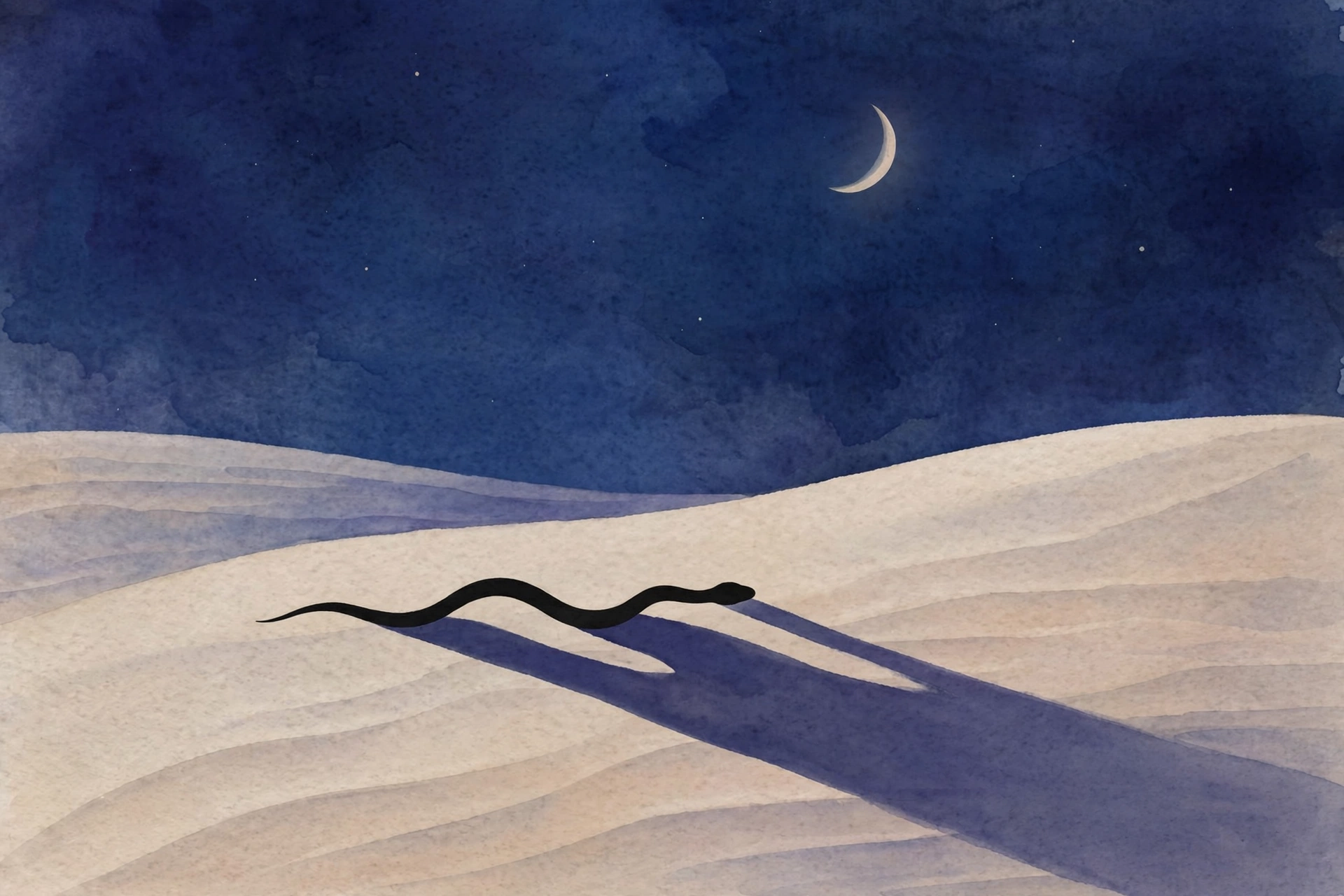
Islamic Meaning of Snakes in Dreams
- In the Islamic dream tradition attributed to Ibn Sirin, a snake most often represents an enemy, frequently a hidden one. The snake’s size suggests the scale of the threat; its behavior reveals whether the hostility is active or dormant.
- Details change the reading: a snake in the house points to someone close, killing the snake suggests overcoming the enmity, and a snake that merely appears may mean a threat that hasn’t moved yet.
- Psychologically, snake dreams track threat detection and distrust. The Islamic reading and the psychological one often point at the same waking-life situation from different angles.
- As with any dream, treat these readings as possibilities for reflection, not certainties. For background on the method behind them, see our guide to Ibn Sirin’s approach to dream interpretation.
Snake dreams are just one symbol. There are 49 more.
Get The 50 Most Common Dream Symbols, our free quick-reference guide that decodes every symbol in this dictionary in plain English.
Snake dreams are just one symbol. There are 49 more.
On this page
Snakes visit everyone’s dreams, and every tradition has something to say about them. In the Islamic dream tradition, the reading is direct and consistent: the snake usually represents an enemy. But as with everything in this tradition, the details, and the dreamer’s life, decide what kind.
We’ll start with the psychology, as we always do, then walk through the traditional readings carefully and respectfully.
What your mind may be doing
Humans react to snakes fast, sometimes before conscious recognition. Threat detection around snakes runs deep in the nervous system, which is why snake dreams feel so vivid and why they cluster around periods of distrust, conflict, or perceived danger.
Psychologically, a snake dream often surfaces when something in waking life feels threatening, deceptive, or out of your control: a relationship that’s developed an edge, a workplace dynamic that’s turned, a worry you can’t quite name. The snake gives the feeling a shape.
Keep this layer in mind as we go through the traditional readings. You’ll notice they keep pointing at the same territory: threats, hidden hostility, the need for alertness. Two different frameworks, centuries apart, circling the same human experience. That’s worth noticing.
The snake as enemy: the core reading
The tradition attributed to Ibn Sirin reads the snake as an enemy, basing the association on the serpent’s role in the deception of Adam, acting at Satan’s instigation. The snake is the archetype of hidden hostility: dangerous, often unseen until it strikes, and associated from the beginning with enmity toward humanity.
This is the baseline. From here, everything depends on the specifics, exactly as Ibn Sirin’s method requires. A snake in a dream is never just “bad.” It’s a question: what hostility, and from where, and at what scale?
It’s also worth remembering the tradition’s humility here. These readings are possibilities offered for reflection, in the spirit of a method that preferred silence over guessing. If none of them fits your life, the dream may belong to the ordinary kind, the mind processing its own material, and needs no interpreter at all.
Size, behavior, and what they reveal
In the traditional readings, two details carry the most weight:
Size suggests scale. A large snake points to a powerful adversary: someone with real capacity to affect your reputation, livelihood, or relationships. A small snake suggests a weaker threat: petty conflict, minor envy, an adversary without serious influence. The tradition even notes venom as a measure: a venomous snake can represent a wealthy enemy, one whose resources are the weapon.
Behavior reveals timing. A snake that merely appears, without attacking, is read as an enemy who exists but isn’t currently acting: the threat is present but dormant. An attacking snake signals active hostility. A snake that speaks words of goodness is read, interestingly, as benefit coming from the direction of the enmity: spoils, advantage, or a turn in your favor.
The principle underneath is one Ibn Sirin applied everywhere: the symbol’s behavior in the dream describes the situation’s behavior in life. Stillness means stillness. Aggression means aggression. The dream is read like a report, not a riddle.
Common snake scenarios in the tradition
- A snake in your house. Read as an enemy among those close to you: household, family, or trusted guests. The domestic setting narrows the field. The tradition’s logic is that the location of the symbol marks the area of life where the meaning applies. Our general guide to dreaming of a snake in your house covers the psychological side of the same image.
- Killing a snake. One of the most positive readings in the tradition: victory over the enmity, deliverance from a danger that nearly caused harm, the lifting of grief. It can also mean overcoming a difficult trial generally. If you woke relieved, the tradition says trust that relief.
- Fighting a snake without killing it. Read as an ongoing struggle: a conflict or rivalry that’s active but unresolved, a risk being navigated. The outcome of the fight in the dream is often read as indicating the direction of the waking situation.
- Being bitten by a snake. The bite’s severity is read as measuring the harm: a serious bite suggests significant damage from the hostility, a minor one suggests limited effect. Psychologically, bites often mark wounds that already happened rather than ones to come.
- A snake obeying or following you. An interesting reversal in the tradition: a snake under your command is read as mastery over the enmity, turning opponents into assets, even attaining position or influence through the situation. The threat transformed into an instrument.
- Many snakes. Read as multiple hostilities or a generally hostile environment: pressures from several directions, gossip, competing adversaries. The appropriate response in the tradition is the same as in life: identify the real ones and don’t borrow trouble from the imaginary ones.
After the dream: the tradition’s counsel
What should you actually do with a snake dream? The tradition’s answer is characteristically practical.
If the dream was merely unsettling, reflect on it the way Ibn Sirin would: ask what hostility, rival, or hidden tension exists in your life right now, and whether the dream’s details match anything real. Often they do, and the dream’s value is simply in forcing the question.
If the dream was genuinely distressing, Islamic guidance treats it as the distressing kind: seek refuge with Allah from its evil, blow lightly to your left three times, turn over, and don’t share it. It is not interpreted. This is one of the tradition’s most psychologically astute rules: some dreams are starved, not studied.
And a general principle worth carrying: the tradition reads the snake as a call to alertness, not to paranoia. The appropriate response to a possible hidden enmity is wisdom and caution, the same qualities the Qur’an and Sunnah commend everywhere, not suspicion of everyone around you. As with the biblical “wise as serpents” (Matthew 10:16), the serpent’s own qualities, alertness, discernment, are the recommended answer to the serpent’s threat.
Frequently asked questions
What does a snake mean in Islamic dream interpretation?
Most often, an enemy, frequently a hidden one. The reading is attributed to Ibn Sirin’s tradition and based on the serpent’s association with deception and enmity. Size suggests the scale of the threat, behavior reveals whether the hostility is active or dormant, and location narrows down where in life it applies.
Is dreaming of a snake bad in Islam?
Not automatically. The tradition distinguishes carefully: a snake you kill is victory, a snake that speaks good is benefit, a merely-present snake is a dormant threat. Only the attacking or venomous snake reads as active danger. And distressing dreams generally are not interpreted at all, they’re handled with the protective practices and released.
What does it mean to dream of a snake in the house in Islam?
Traditionally, an enemy among those close to you: family, household, or trusted guests. The house setting is read as pointing to the dreamer’s intimate circle. It’s worth treating as a prompt for honest reflection about close relationships rather than as an accusation against anyone.
What if I dream of killing the snake?
The tradition reads this very positively: overcoming enmity, deliverance from danger, the end of a trial. It aligns with the general principle across traditions that defeating a threat in a dream reflects real resilience. Our article on dreaming of killing a snake explores the same image psychologically.
How do I know if my snake dream needs interpretation?
The tradition’s own answer: if it was a true, clear dream that stayed with you, reflect on it. If it was distressing, don’t interpret it, follow the protective practices. If it was ordinary processing, let it pass. When in doubt, the tradition modeled humility: it’s always permitted to simply not know.
Alert, not afraid
The Islamic tradition’s snake readings come down to a single posture: alertness. Not fear, not suspicion, not obsession with hidden enemies. Just the clear-eyed attention that sees what’s actually there.
That’s a good posture for any dream, in any tradition. The snake in your dream may or may not be an enemy. But the attention the dream asks for, to your relationships, your surroundings, your own discernment, is useful regardless. Take the alertness. Leave the fear.
For the broader method behind these readings, see our guide to Ibn Sirin’s approach to Islamic dream interpretation. Our free guide to the 50 most common dream symbols, from the psychological angle, is at dreamevaluator.com/free-dream-symbols-guide/.
Leave a Reply